
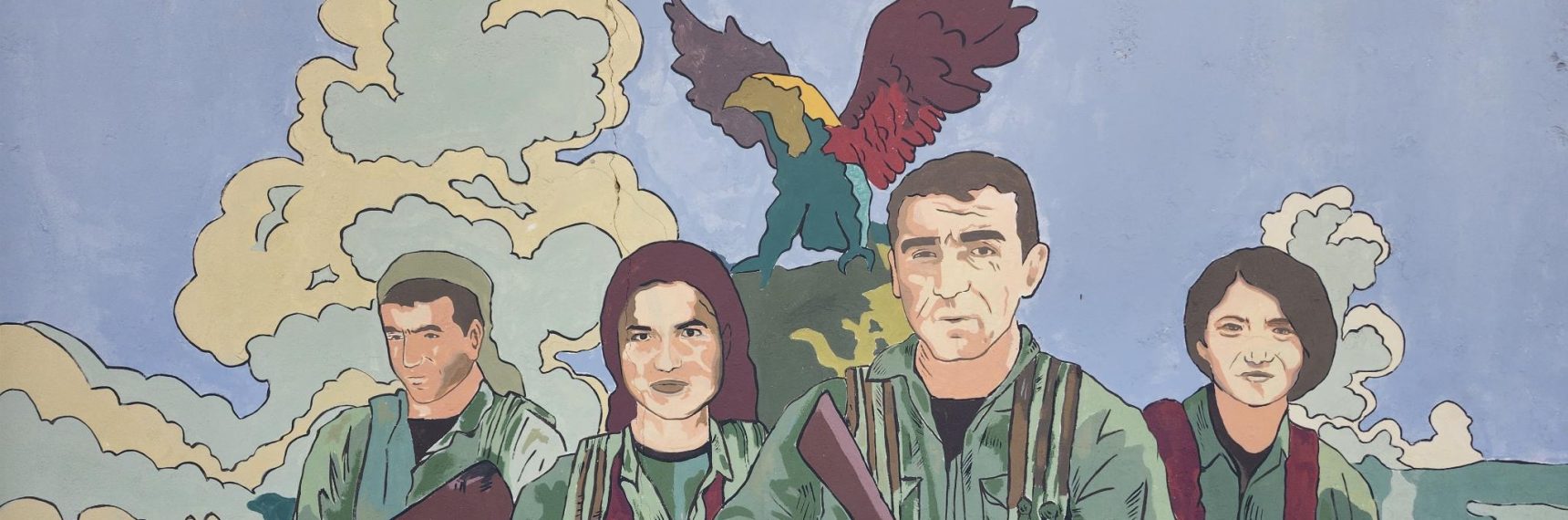
My city defended the world from ISIS. Why is it still under siege?

The land between the Tigris and the Euphrates, the homeland of the Kurds, played host to the development of the earliest human civilizations. Throughout history, the Kurdish people have been a peace-loving people who have lived, and continue to live, alongside other components and nations.
Despite this, the Kurds have always come face to face with massacres. After the Treaty of Lausanne and the definition of the borders that divided Kurdistan, the states that occupied Kurdish land used all their power to assimilate or eliminate Kurdish communities.
At the same time, though, there was another reality: Kurds always resisted and demanded the formal recognition of their rights by the states of Turkey, Iran, Iraq and Syria. The Kurdish struggle for rights reached its highest point through the Rojava Revolution and, in particular, the resistance of the Kurdish city of Kobane, where I am from.
Here, I will discuss the resistance of Kobane, its importance for Kurdish people and international powers, and the reasons why this city is now under siege. I want the world to remember what our people have done to protect them from ISIS, and to now stand with us in our time of need.
Many readers may not have heard of Kobane before. This city is located on the Syrian-Turkish border. To the north are Pirsus (Suruc) and Riha (Sanliurfa). To the south is the town of Sirrin. The Euphrates River passes between Kobane and the cities of Manbij and Jarablus to the west. To the east is Gire Spi (Tel Abyad).
Kurdish society in Kobane is still a tribal society. Its people are known for their bravery and refusal to give up.
In 1973, when the Baath regime began its ‘Arab Belt’ project, intended to break up the Kurdish demography of regions of northern Syria, the name of the city was changed from ‘Kobane’ to ‘Ain al-Arab.’ The people of Kobane did not accept this and always defended their city’s original name. They also rejected the imposition of the Arab Belt in their region. To this day, the residents of Kobane are the original Kurdish residents of the area.
Because of this defiance, Kobane was always ignored and under-developed. For several years, many parts of the city had no running water – the water system broke and Baathist authorities refused to fix it. Many towns and villages lacked electricity and paved roads.
In the summer of 2014, after ISIS seized Mosul, launched a genocidal attack on the Yezidi community of Sinjar, and invaded much of Syrian territory, regional armies found themselves unable to stop its advance. The jihadist group set its sights on Kobane as its next target.
By attacking Kobane specifically, ISIS hoped to destroy Kurdish gains. Kobane was where, in July of 2012, Kurds announced the expulsion of Baathist forces from their areas and the start of the Rojava Revolution. In January 2014, they declared the establishment of an autonomous Canton of Kobane, one of three cantons of Rojava. For the first time, Kurds in Syria had their own administration and were able to govern their areas themselves. ISIS wanted to destroy this project and end Kurdish existence in Syria.
ISIS also sought to control the entirety of the Syrian-Turkish border, which would allow fighters and resources to flow into and out of Syria with ease.
Turkey saw an ISIS presence on its border as preferable to an autonomous Kurdish region. Evidence now shows that the Turkish government and other foreign powers were, tacitly or actively, supportive of ISIS when it turned its sights on Kurdish regions. Turkey, from the foundation of the Republic in 1923 until today, has always done everything it could to ensure that Kurds gain nothing and do not achieve legal rights and recognition.
But there is a Kurdish saying: ‘Siwar hatin, peya çûn’ – ‘they came on horseback and they left on foot.’ In the resistance of Kobane, this saying came to life.
For the first time, Kurds from all parts of Kurdistan united in defense of one Kurdish city. The guerrillas of the Kurdistan Workers’ Party (PKK) came down from the mountains to fight. The Kurdistan Region of Iraq sent its peshmerga forces. Many young men and women from across Kurdistan joined the general mobilization and headed to Kobane of their own initiative. Around the world, the Kurdish diaspora rose up in protest.
This display of Kurdish strength and unity had a major impact on the international community. World powers realized that, if they wanted to defeat ISIS, they had to support the Kurds. Ultimately, the Global Coalition to Defeat ISIS intervened in support of the Kurdish fighters.
In the afternoon of January 26th, 2015, Kurds raised their flags over Kobane. The plan for the elimination of the Kurds of Kobane had been foiled for the time being.
However, the victory at Kobane was not in the interest of some powers. On June 26, 2015, with the support of the Turkish state, ISIS committed a massacre against the people of Kobane.
I witnessed both ISIS’ September 2014 attack and the massacre of June 2015. Our neighbourhood was a small neighbourhood in Kobane called Muxtele. About 100 families lived there. In the June attack alone, almost 30 people from Muxtele were martyred.
That morning, we woke up to the sound of explosions and bullets. ISIS had completely surrounded the neighborhood. We could hear children screaming. The earth was red with blood.
I was just thirteen years old. I will never forget how my childhood friends Şêrîn, Zanav, Mihemed and others were killed, seeing the blood leave their bodies, being unable to do anything. The dreams of those children were destroyed that day. As long as I live, I will never forget how ISIS, with the support of Turkey, attacked and killed my friends. As I write about this now, I become emotional. There are no words to describe it.
Even after these tragedies, our people worked to bring our city back to life. Everything that had been done by the new Autonomous Administration to address Baath-era neglect in the months before ISIS attacked was destroyed in the ISIS war. No international organizations came to help. But with the support of Kurds in the diaspora and Kurdish municipalities in Turkey, the people of Kobane rebuilt their homes, businesses, and public institutions themselves, better than the Syrian state had ever done.
Four years later, Kobane would once again find itself on the front lines. In 2019, when Turkey invaded Gire Spi and Serekaniye, Kobane was cut off from the rest of Rojava and northeastern Syria. In 2020, the drone war that would devastate our infrastructure and take away many of our political and military leaders began in the village of Helince. Three members of Kongra Star, a women’s organization, were assassinated in a Turkish strike on a civilian home on June 23rd of that year. Children learned to recognize and fear the sound of drones. Farmers were unable to approach their land close to the borders. Many people fled Kobane for other cities in northeast Syria.
The fall of the regime did not mean the end of war in Kobane. On January 6th, 2026, armed groups affiliated with the Syrian Transitional Government, with the support of Turkey, Qatar, and other forces, launched an attack on the Kurdish neighborhoods of Sheikh Maqsoud and Ashrafiyah in Aleppo. After invading these neighborhoods, they took the Arab-majority regions of Raqqa, Deir Ezzor, and Tabqa that had been under the control of the Syrian Democratic Forces (SDF). Finally, they turned their sights on Kobane and Jazira.
By January 20th, these two Kurdish areas of Syria were completely isolated from each other. Jazira has a border crossing with the Kurdistan Region of Iraq, which allowed aid, international organizations, and other forms of support to come in. Kobane was surrounded on all sides. Water, power and Internet were completely cut off.
Ten days later, on January 30th, the SDF and the transitional government announced a comprehensive ceasefire and integration agreement. But the city of Kobane, which protected the entire world from ISIS, is still under siege.
My work as a journalist has brought me to Qamishlo, but my family remains in Kobane. Their situation is very difficult. I spoke with them just days ago. They told me that many people are becoming sick from contaminated water. Diseases are spreading and medicines are running out. Because of the large number of patients and the limited resources, hospitals are unable to treat people effectively. They do not have electricity. Every day, supplies of vegetables and other necessities run lower.
Radical groups affiliated with the government continue to surround Kobane, restricting necessities like medicine and fuel from entering and people from escaping. They refuse to leave nearly 50 villages administratively affiliated with the city, where they have been documented to have looted and destroyed civilian homes. Residents of those villages were forcibly displaced to the city center, where they shelter in schools. Water, power, and Internet have been restored, but to levels far lower than are necessary.
The humanitarian situation grows more dire with every moment. Although the integration process stipulated by the January 30th agreement has begun, Kobane has not seen peace and relief. This creates suspicion among many Kurds as to how serious the transitional government is about implementing its commitments. The siege of Kobane intends to force people to leave their homes and abandon their land so that the demographics of the region are changed. In this way, they want to prevent Kurds from gaining their rights.
If the situation in Kobane continues like this, this region will face a humanitarian catastrophe. Developments could easily spiral out of the control of all parties. To prevent such an outcome, the government must lift the siege, remove its forces from Kurdish villages, and commit to the promises it made and the implementation of the integration deal.
I talk to people who remain in Kobane every day. Their children die from cold and illness in front of their eyes. They can do nothing because of the siege. A mother with whom I spoke said: “This is our land, and we won’t hand it over to any invaders.” I want to ask the world on her behalf: the people of this city that defended you from ISIS are facing a massacre. Why are you silent? Does silence not mean acceptance?
Topics & Regions
About the Author

Topics & Regions
Explore More
For Syrian Kurds, Mother-Tongue Education is a Red Line
Related Research
Multilingual Education Will Help Syria Succeed

The SDF-Damascus Deal and the Kurdish Question: Prospects for Peace