
The Coalition of Political Forces of Iranian Kurdistan: Risks and Opportunities

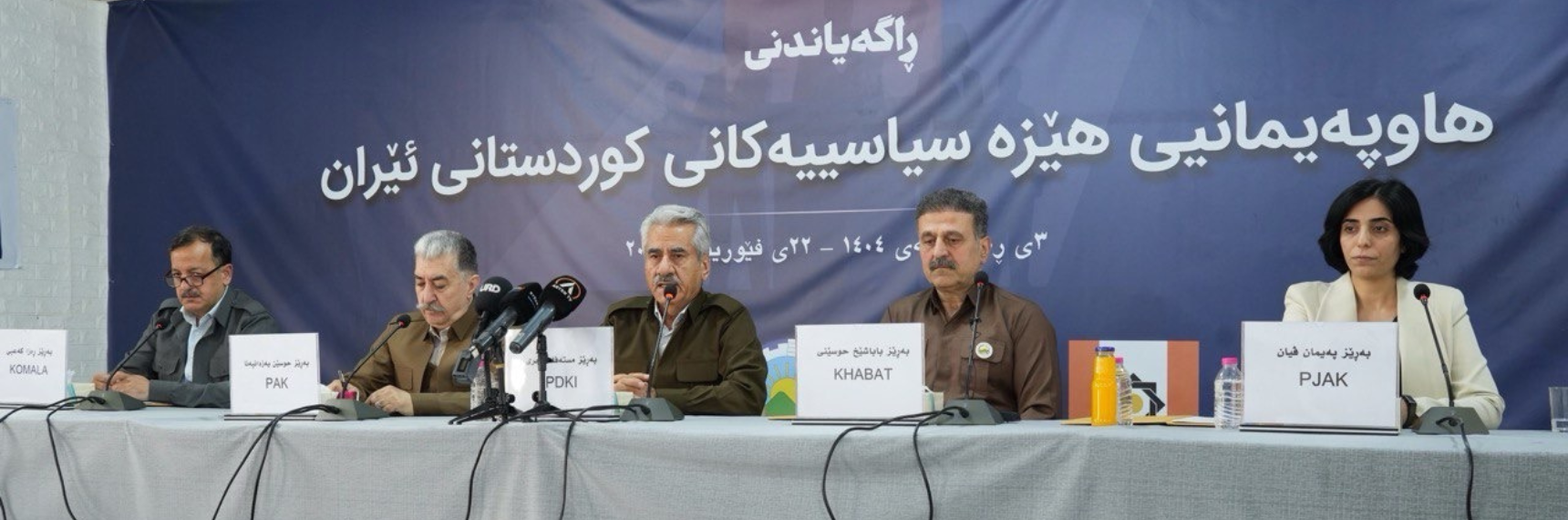
Five major Kurdish opposition parties announced the formation of the Coalition of Political Forces of Iranian Kurdistan on February 22nd. The Democratic Party of Iranian Kurdistan (PDKI), Kurdistan Free Life Party (PJAK), Kurdistan Freedom Party (PAK), the Khabat Organization, and Komala – Toilers of Kurdistan committed to working together for the “overthrow of the Islamic Republic of Iran,” “the realization of the right of the Kurdish people to self-determination,” and “the establishment of a national and democratic institution based on the political will of the Kurdish people in Iranian Kurdistan.”
The Coalition is the outcome of intensified unity efforts following the 2022 ‘Women, Life, Freedom’ uprising, the Israel-Iran war of June 2025, and, most recently, a bloody regime crackdown on protests in January 2026 that left thousands dead. The outbreak of war between the United States and Iran on February 28th will put its political and military capacity to the test.
Formation and Context
The groundwork for this convergence was laid months earlier, when all seven major Iranian Kurdish parties, including Komala – Kurdistan Organization of the Communist Party of Iran and Komala of Iranian Kurdistan, held a joint conference in Cologne, Germany with the aim of strengthening solidarity and coordination among different social and political movements.
There, the participants reaffirmed their commitments to the “Woman, Life, Freedom” movement and emphasized the need for sustained collaboration moving forward. In their final joint statement, party representatives stressed that “relations with the international community should be developed in a systematic and sustained way” to better deliver the legitimate demands of the Kurdish people in Iran and called for strengthened cooperation with political and social actors both inside and outside the country.
On January 5th, 2026, as protests across Iran were entering their second week, the seven parties held a “high-level meeting” at the initiative of the Dialogue Center for Inter-Party Cooperation and agreed to work on a shared roadmap for the advancement of Kurdish interests.
They subsequently issued a call for a general strike on January 8th, which was widely observed across 39 cities and towns in Iranian Kurdistan, underscoring the exiled parties’ reach and influence.
Building on the foundation of the Dialogue Center, five of the seven parties took a significant step forward by formally establishing the Coalition of Political Forces of Iranian Kurdistan on February 22nd.
The Framework
The Articles of Cooperation that underpin this platform reveal a broad and ambitious political vision. Self-determination for the Kurdish people in Eastern (Iranian) Kurdistan sits at the heart of the framework, while solidarity with other oppressed nations in Iran is pursued on the basis of shared democratic goals. Notably, cooperation with nationwide opposition forces is made conditional on the recognition of the Kurdish right to self-determination, signalling that this cannot be treated as a negotiable concession.
Equally significant is the charter’s commitment to a future democratic administrative system that guarantees the rights of all ethnic groups, religions, and communities in Iran, alongside a firm emphasis on gender equality and justice across all spheres.
Structurally, the charter calls for the formation of a joint diplomatic committee for international engagement and lays the groundwork for a unified command center for peshmerga and guerrilla forces within a coordinated defense strategy. The struggle is mapped out in two distinct phases: first, the liberation of Eastern (Iranian) Kurdistan, then the construction of democratic governance with a central body from the alliance tasked with overseeing liberated areas and organizing free elections thereafter. In this sense, the very creation of such a charter represents a deliberate attempt to institutionalize unity within a movement that has historically been fragmented.
Notable Absences
Two parties involved in the initial Dialogue Center — the Komala Party of Iranian Kurdistan and Komala – Kurdistan Organization of the Communist (Komala – CPI) Party of Iran — refrained from joining the new alliance.
The Komala Party of Iranian Kurdistan, led by Abdullah Mohtadi, welcomed the Coalition’s formation but stopped short of joining, citing lack of clarity and substantive policy prescriptions on key issues such as the transitional administration of Iran’s Kurdish regions and the unification of armed forces.
Komala – CPI, led by Ahmed Salihi, revealed that one of the reasons they did not join was the coalition’s refusal to adopt the international communist anthem alongside the Kurdish national anthem.
A Brief History of Kurds in Iran
Between 7 million to 15 million Kurds live in Iran, making them the third largest ethnic group in the country after Persians and Azeri Turks. The disparity in population data reflects the absence of updated demographic consensus data, due to political sensitivities primarily driven by the Islamic Republic’s deliberate securitization of ethnic and religious minority identities.
Similar to Kurds in Turkey and Syria, Rojhelati (Iranian) Kurds have been denied basic rights for over a century. Kurdish persecution in the modern-day Iranian nation-state began under Reza Shah Pahlavi, who sought to forcefully homogenize the state through violent centralization and assimilation of non-Persian communities. In doing so, the Pahlavi era entrenched a policy of institutional securitization, portraying the Kurds as an inherent threat to the Iranian state in a policy that the Islamic Republic would go on to inherit and deepen.
Organized Kurdish political opposition parties have been active in the country since the 1940s. The PDKI established the Republic of Kurdistan in Mahabad on 15 December 1945; the Pahlavi regime subsequently overthrew the Republic and publicly executed its leadership.
The nature of the Kurdish struggle in Iran changed in the 1970s with the election of Abdul Rahman Ghassemlou, who advocated for Kurdish autonomy within a democratic Iran, as chairman of the KDPI. Yet Kurdish hopes for local self-rule were crushed with the newly empowered Islamic Republic’s uncompromising policy, which called for their immediate disarmament without any guarantees of political or cultural rights.
The Kurdish opposition movements were the first to reject the imposition of this new order by boycotting the 1979 referendum to create an Islamic state. In his first speech in Qom in 1979, Ayatollah Ruhollah Khomeini categorized Kurdish leaders as “evil of the earth” and publicly declared jihad against the entire Kurdish population later that year.
Since then, the Kurdish experience in Iran has been shaped by sustained repression, regional militarization, and systematic cultural and political marginalization. In 2025, Kurds alone accounted for nearly half of all state detainees — a figure highly disproportionate to their 8% to 17% share of the total population.
The Iranian Kurdish Opposition Today
Today, the Kurdish parties are the only segment of the broader Iranian opposition with battle-tested armed forces. The different Komala factions, PDKI, PJAK, and PAK have all waged on and off armed campaigns against Tehran. The Kurdistan Freedom Party (PAK), which claimed attacks on IRGC positions during the January protests, was trained by the US military and played a crucial role in the frontlines of the war against the Islamic State in the Kurdistan Region of Iraq.
The parties’ ability to mobilize mass political action in the Kurdish regions in Iran, also suggests a superior organizational capacity. While assessing the influence of each individual party remains difficult, their collective success is evident in instances such as their repeated ability to bring shopkeepers to shutter their stores in general strikes, including during the 2022 Woman, Life, Freedom uprisings.
The Kurdish parties’ decades-long history of organized resistance and institutional survival, combined with their demonstrated military and organizational capacity, sets them apart from much of the Iranian opposition. Their cross-border presence also affords them access to a broader regional Kurdish pool, strengthening their ability to replenish and expand their ranks in ways that few other opposition forces can. PJAK, for instance, which is inspired by Abdullah Ocalan’s democratic confederalist ideology, sent fighters to Syria to gain experience combatting ISIS in 2014 and has reportedly absorbed fighters and infrastructure from the PKK as the latter’s structures began to contract in Iraq and Syria last year.
Opportunities and Risks
Kurdish civilians have been seen celebrating the announcement of Iranian Supreme Leader Ali Khameini’s death. Kurdish parties have not yet issued any public reactions to the conflict. They are likely to prioritize concrete steps to protect Kurdish populations over public commentary.
In the event of partial or total regime collapse in Iran, the Coalition could find itself at a historic inflection point. If member forces manage to coordinate effectively, Kurdish actors would be well-positioned to move swiftly and establish a meaningful presence across Iran’s Kurdish regions, advancing decades-old claims to self-determination and seeking international recognition as a legitimate political actor in any post-Islamic Republic order. The prospect of building an inclusive democratic society with protected rights for Kurdish and other communities would lend the project both domestic legitimacy and international appeal.
The risks are substantial, though, and would test the Coalition’s cohesion from multiple directions.
Insufficient coordination among member forces remains the most immediate vulnerability, as a fragmented response to a fleeting window of opportunity could prove more damaging than no response at all.
If conflict intensifies in Iran, Turkey has signalled that it may intervene militarily, framing any move as a necessary measure to control refugee flows or prevent the spillover of Kurdish demands in an extension of the ‘buffer zone‘ logic it deployed in Syria. Ankara has demonstrated the willingness to act unilaterally in such contexts, and a destabilized Iran would present a tempting strategic opening. Such a development would significantly unsettle the regional balance of power and would not sit well with Israel, which has little appetite for an expansion of Turkish influence in the region.
Azerbaijan, emboldened by Ankara, could similarly seek to mobilize Iranian Azeris against Kurdish aspirations. This is a particularly sensitive fault line. Kurds and Azeris share geographic proximity and in some areas even share cities and towns, with a history of ethnic tension between the two communities that outside actors could seek to exploit.
The Kurdistan Region of Iraq (KRI), where the Kurdish parties operate, would also come under severe pressure. The region has historically walked a difficult tightrope, maintaining working relations with Tehran while hosting the very opposition parties that Iran views as existential threats. In recent statements, Erbil has made it clear that it will not permit actors on its territory to threaten the territorial integrity of neighboring states, a posture mainly driven by self-preservation. Yet in practice, all major exiled Kurdish factions operate out of the KRI, and Iran has never hesitated to strike targets there when it deems it necessary. The Islamic Republic has already launched retaliatory strikes on both U.S. targets and the bases of Kurdish parties in and around Erbil.
The Coalition would also need to navigate a crowded and competitive opposition landscape. Tensions with monarchist factions were already on display within days of its announcement. Reza Pahlavi publicly condemned the alliance as separatist, drawing a sharp rebuke from Kurdish parties and activists. There is a real risk that these divisions deepen in a post-collapse environment, where competing visions for Iran’s political future could inevitably clash with Kurdish aspirations for self-determination.
Yet for all the risks, the Islamic Republic has rarely been more vulnerable than it is today. Sustained domestic unrest, economic deterioration, and now foreign military action have converged to create a moment of genuine uncertainty for the regime. The Kurdish parties are better placed than most to act decisively should that window open.
To maximize their position, the coalition would do well to intensify lobbying efforts in Western capitals, where Kurdish parties already maintain contacts but have yet to fully translate them into durable political support.
Seeking closer alignment with other regional Kurdish actors would further strengthen their hand, as a unified Kurdish front across borders carries far more weight than fragmented individual efforts.
There is also a compelling case for building alliances with other marginalized communities within Iran, who share a broadly similar vision of local self-rule and the protection of cultural and religious rights.
In a scenario where a weakened Islamic Republic remains in place, the formation of the Coalition remains a significant and historic development in its own right. For a movement long defined by fragmentation, the coming together of five major parties under a shared charter represents a meaningful shift. A period of relative stability could serve the Coalition well, providing the space to deepen its organizational roots, expand its base among Iranian Kurds, and attract the manpower and expertise needed to sharpen its long-term strategy.
Whichever scenario unfolds, the Coalition has already altered the landscape of Kurdish political opposition in Iran in ways that are unlikely to be reversed.
Topics & Regions
About the Author
Topics & Regions
Explore More
YPJ Integration: What are the Obstacles?

Related Research
The SDF-Damascus Deal and the Kurdish Question: Prospects for Peace
Iran’s Kurdish Parties Work Towards Unity as Protests Escalate