
How to Invent a War

Six days into the U.S.-Iran war, just after midnight Erbil time, Chief National Security Correspondent at Fox News Jennifer Griffith made a shocking allegation. “Thousands of Iraqi Kurds have launched a ground offensive in Iran: US official tells Fox,” she posted on X.
It would have been a logic-defying reversal. The Kurdistan Regional Government (KRG) maintains relations with both Tehran and Washington. Iran is an economically and militarily weighty neighbor, while American support helped create the autonomous region and now strengthens it vis-a-vis the central state in Baghdad. As fighting broke out, Iraqi Kurdish leaders stressed peace, not partisanship.
Kurdish social media soon lit up with denials. “Not a single Iraqi Kurd has crossed the border. This is patently false,” Aziz K. Ahmad, deputy Chief of Staff to KRG Prime Minister Masrour Barzani, responded.
Two hours later, Griffin amended her story. “Clarification: I am told these are Iranian Kurds who fled in the past and have been living in Iraq. They are returning with the hopes of starting an uprising so that the people of Iran feel comfortable rising up against the remnants of the regime. US official confirms to Fox News that thousands of Kurds have launched a ground offensive in Iran. They are crossing in from Iraq. There are conflicting reports tonight. Will update when we know more,” she posted.
Iranian Kurdish opposition parties swiftly rejected the claims. These movements have been active in Iran’s Kurdish regions, known as Eastern Kurdistan or Rojhelat, for decades, at times holding territory out of central state control. After the 2022 ‘Women, Life, Freedom’ uprising and the 12-Day War of June 2025, they had intensified their organizing.
But they never decided to join the war. Kurdish parties denied military movements on their official social media accounts and in comments to Kurdish news outlets.
In the following weeks, Kurdistan would become a battlefield – but not one that Kurdish forces on either side of the border had chosen.
U.S. and Israeli strikes targeted military and security infrastructure in Iran’s heavily securitized Kurdish borderlands. According to human rights monitor Hengaw, 290 “military, security, and administrative sites” were struck in four Kurdish provinces before a ceasefire was reached in mid-April, killing over 1,500 military and security personnel and over 100 civilians. Meanwhile, Iran and its Iraqi proxy forces struck U.S. military and diplomatic facilities in the neighboring Kurdistan Region of Iraq (KRI). The bases of Iranian Kurdish parties also came under fire. Kurdish news outlet Rudaw reported that over 700 missiles and drones were launched at the KRI, killing 17 people and injuring 92.
Kurdish leaders and civilians alike focused on survival and security. So why, in the Western media, was an ‘invasion’ or ‘uprising’ always just around the corner? Decontextualized and biased narratives gave legitimacy to exaggerated or outright false claims from state actors who may have sought to influence events on the ground rather than describe them.
Language Matters
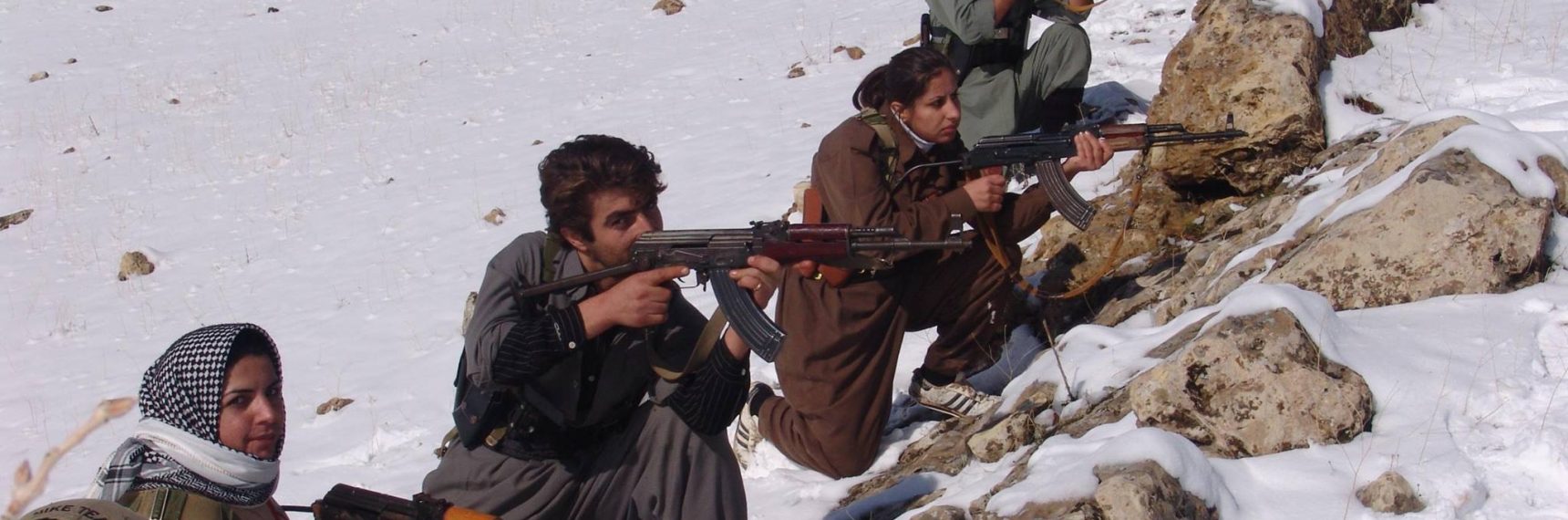
The problem begins with the very language that is (and is not) used to describe Kurdish movements. Journalists and analysts covering the supposed ‘uprising’ cast parties committed to a democratic, multi-ethnic Iran as ‘separatists’ and Kurdish armed forces older than some modern states as ‘militias.’
While many Kurds dream of a country of their own, most Kurdish parties today demand decentralization and equal rights within the borders that exist, similar to the constitutional status enjoyed by Kurds in Iraq. The Coalition of Political Forces of Iranian Kurdistan, a seven-party alliance including both leftist and classic nationalist currents, is committed to national rights for Kurds and other minorities within a democratic and decentralized state.
“In countries such as Iran and Turkey, many Kurdish political activists have been sentenced to long prison terms or even executed under accusations of separatism. Describing Kurdish parties in this way therefore reproduces the very accusations made by the central governments of Iran, Turkey, Syria, and Iraq. Such language contributes to the dehumanization of Kurds and helps legitimize the repression of the Kurdish democratic movement in their homeland,” said Behnam Zarei, a Kurdish journalist.
Writing on her X account, commentator Kijan Shano tackled the question of why Kurdish parties are not militias: “To many Kurds and international observers, these groups are seen as legitimate political movements with armed wings necessitated by history, whereas their opponents often use the term “militia” or “terrorist” to delegitimize them.”
“Unlike a militia led by a “warlord,” these groups are led by Secretaries-General and Central Committees elected at party congresses. Their military wings are strictly subordinate to the party’s political wing. They aren’t just fighting; they have detailed manifestos on secularism, gender equality, and federalism. They provide social services to their members in exile, including schools and media,” she continued.
The Kurdistan Freedom Party (PAK), a member of the Coalition of Political Forces of Iranian Kurdistan that has fought the Islamic Republic since the 1990s, is pushing back against inaccurate language. PAK formally requests that journalists who engage with it refer to its fighters as peshmerga, a Kurdish word that means ‘those who face death’ and has been used to refer to Kurdish armies for a century.
“For us, the term Peshmerga carries national, ethnic, and moral value. When this name is replaced with terms like “militia” or “armed group,” it undermines and disregards our history and our values and our fallen Peshmerga,” Hana Yazdanpaneh, a PAK spokesperson, told me.
Erasing History
The bias didn’t stop at the inclusion of disparaging language. Western media outlets also chose to exclude Rojhelat’s rich history of resistance and self-governance.
“International media have largely reduced the “Kurdish question” to the armed dimension of Kurdish parties and organizations. They have highlighted this aspect selectively, often in line with their own interests and the prevailing geopolitical context. This is despite the fact that Kurds—particularly in Rojhelat – have a rich and long history of political struggle,” said Behnam Zarei.
“There are political parties that have existed for more than eighty years. This part of Kurdistan also experienced the establishment of the Republic of Kurdistan in Mahabad under the leadership of Qazi Muhammad in 1946. Civil society and civic activism have always been a central component of the Kurdish question in Rojhelat,” he continued.
Azadi*, a Kurdish researcher using a pseudonym to protect relatives inside Iran, warned that mainstream reporting also leaves out the reasons why Kurds are willing to put up such a fight.
“What is also missing…is the everyday political reality for Kurds in Iran: restrictions on language and cultural expression, limitations on political organizing, and economic marginalization in Kurdish regions. Without this context, the Kurdish issue is often framed purely through geopolitics rather than as a question of rights, governance, and representation for communities with longstanding grievances that existed well before the Islamic Republic came to power,” they said.
A reader learning about alleged U.S. engagement with Kurdish opposition parties from Axios or CNN would have only learned that the CIA had a nebulous plan to arm them. They would not know that Kurds in Iran had been armed and organized since before the CIA existed, or that they had twice turned those arms against the U.S.-backed monarchy in response to repressive policies not so different from those of the Islamic Republic. This allows Kurds to be framed as proxies of foreign powers, not actors with their own interests – a narrative used to justify disappearances, executions, and bombings.
The War That Wasn’t
When journalists and analysts exclude historical context and reduce movements to epithets, it is difficult to understand who exactly is involved in a conflict and what it is that they are fighting for. These subtle choices create the environment in which a logically impossible military operation can spread. It may have been the perfect setup for actors who wanted to instrumentalize Kurdish struggle for their own ends.
Matthew Petti, an assistant editor at Reason Magazine (and a former non-resident fellow at the Kurdish Peace Institute), has broken stories on U.S. foreign policy in the Middle East. I asked him for a journalistic perspective on the process that could have brought the non-existent Kurdish invasion to the headlines.
“Without any inside knowledge, it looked like a coordinated leak by the administration. A lot of journalists on the Pentagon and White House beats were simultaneously briefed on a nearly identical story. These beats tend to be really controlled reporting environments. You’re in physically constrained spaces getting all your information from officials whether through authorized or unauthorized channels. The measure of credibility is not necessarily whether you can corroborate the story on the ground but whether you can get it from multiple officials,” Petti explained.
Many people in the region believe that the U.S. used the threat of an implausible war as a tactic – and that it made conditions for Kurdish self-determination on both sides of the border more dangerous, not less.
Kurdish parties themselves have considered this possibility. Zagros Enderyari is the Foreign Affairs spokesman for the Kurdistan Free Life Party (PJAK), a member of the Coalition of Political Forces of Iranian Kurdistan known to have forces inside Iran’s borders. He affirmed that reports of Kurdish involvement in the war were “not accurate and have no factual basis.”
“One possibility is that these reports are part of psychological warfare, intended to increase political and psychological pressure on the Islamic Republic of Iran. It is well known that Kurdish parties in Iranian Kurdistan—especially PJAK—have certain capacities and influence in regional dynamics, and this may encourage such speculation,” Enderyari said.
Leakers may have also wanted to push the Kurds to act when it became clear that the Iranian state would not collapse from airstrikes alone – no matter the consequences.
Though few will say it outright, activists, diplomats, and others have suggested this in private conversations. Many recall the carnage of 1991, when the U.S. urged Iraqi Kurds to rise up against Saddam Hussein then failed to intervene until after his regime had killed and displaced countless civilians.
If this was the strategy, it seems to have had the opposite effect: “The forewarning gave both the Iranian and Turkish governments time to mobilize preemptively, and the cynicism of it all probably spooked Kurdish parties that were already worried about the U.S. exposing them to danger without guarantees,” said Petti.
Days before the U.S. and Iran reached a ceasefire, U.S. President Donald Trump played the Kurdish card again. Speaking to Fox News, he claimed that Kurds had ‘kept’ weapons sent by the United States for Iranian protestors. The Coalition of Political Forces of Iranian Kurdistan denied it – but the damage was done.
Kurds and Kurdistan are excluded from the fragile pause in a war they never chose to join. According to Community Peacemaker Teams, Iran and its proxies hit Rojhelati opposition bases 37 times since the ceasefire began, killing at least four peshmerga. Iraqi Kurdish facilities were targeted seven times. Just four strikes hit U.S. facilities.
Residents of the KRI’s major cities are accustomed to the sound of drone strikes and interceptions. In Rojhelat, executions and arrests are a near-daily occurrence. Human rights activists fear a crackdown worse than the one that followed the ‘Woman, Life, Freedom’ uprising.
None of this makes the headlines. Reporters who flocked to the region to cover a battle that never materialized have long since gone home. That the reality of war in Kurdistan has drawn less attention than a possible war constructed by unnamed foreign officials ought to be cause for reflection. So, too, should the fact that the conventions of reporting on Kurdish issues made these claims believable.
(Photo: PDKI Fighters by Kurdishstruggle, CC BY 2.0)
Topics & Regions
About the Author
Topics & Regions
Explore More
Iran’s Kurdish Alliance Says Their Struggle Will Continue

Related Research
YPJ Integration and the Future of Women’s Rights in Syria
For Syrian Kurds, Mother-Tongue Education is a Red Line

The Coalition of Political Forces of Iranian Kurdistan: Risks and Opportunities