
Preserving Inclusive Governance in Northeast Syria During Integration
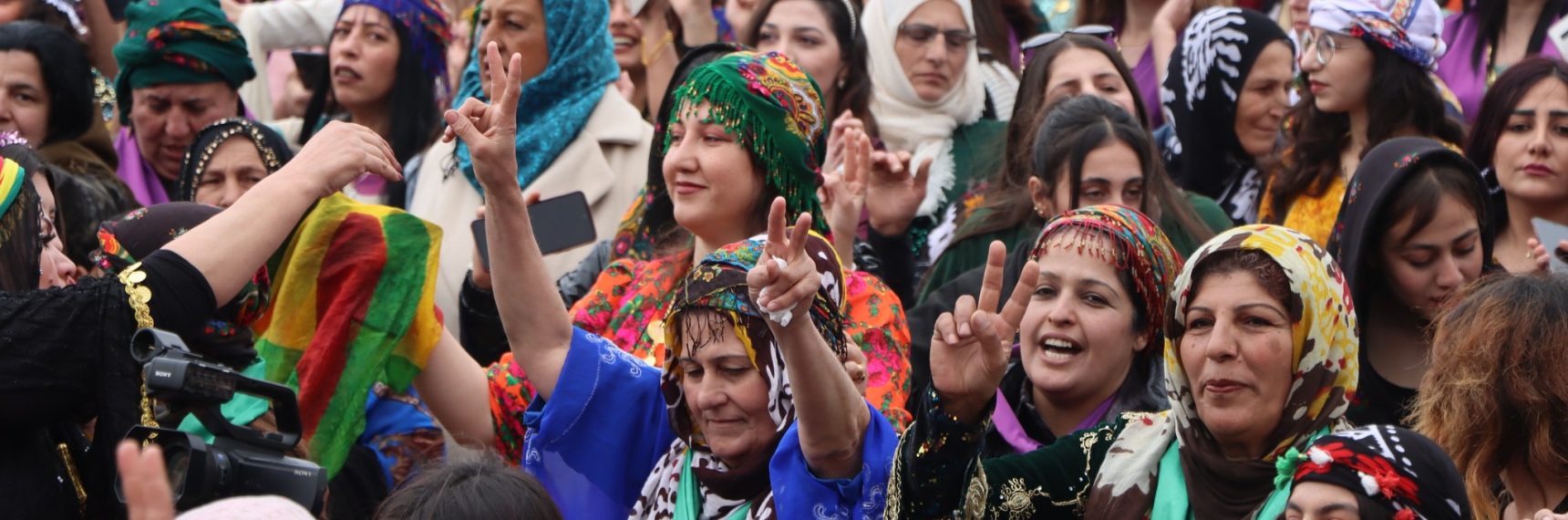
As the integration of Northeast Syria into the Syrian Transitional Government progresses, it is important to document the inclusive governance structures that have helped sustain social cohesion and relative stability in the region over the past decade, even amid war, economic hardship, displacement, and ongoing security threats.
While much international attention has focused on military developments and counterterrorism efforts, far less attention has been given to the local systems of governance that enabled diverse religious and ethnic communities to continue living together during one of the world’s most devastating conflicts. These structures, as part of the Democratic Autonomous Administration of North and East Syria (DAANES), also helped foster some of the strongest protections for religious freedom, women’s participation, and minority inclusion in the region.
Understanding how these governance structures functioned — and carefully monitoring how integration is implemented — will be essential to ensuring that Northeast Syria continues to include all religious and ethnic communities in political and civic life, including women. The future of these institutions will not only shape the stability of Northeast Syria but will also serve as an important indicator of whether Syria as a whole can move toward a more stable, inclusive, and durable peace.
DAANES institutions built fair representation into local governance.
This paper focuses on the Jazira Region, which corresponds largely to the Hasakah province and includes many of the region’s most diverse religious and ethnic communities. This region remained under the control of the SDF when the January 29th integration agreement was signed. As a result, local governance structures largely continue to function as before. Like other regions in Northeast Syria, this region has been administered through a council system designed to distribute authority across ethnic, religious, and political communities.
In the Jazira Region, corresponding roughly to the province of Hasakah, the local People’s Council included 57 Kurds, 24 Arabs, 17 Syriacs, 1 Armenian, 1 Chechen, and 1 Yezidi.
The co-chair system, in which all leadership positions were shared by one male and one female co-chair, ensured fair representation for women in DAANES structures. It also promoted ethnic and religious diversity: co-chairs often came from different communities. Research shows that this system encouraged collaborative decision-making among people of different backgrounds – an important basis for democracy.
In Jazira, the Regional Executive Council was led by one Kurdish and one Syriac co-chair, with one Kurdish and one Arab deputy co-chair. The council was made up of the co-chairs of 13 different authorities. In total, within these authorities, there were 61 leadership positions held by 122 co-chairs – 61 men and 61 women.
Another measure the DAANES took to increase women’s participation was a 40% quota for women’s representation. For most institutions, this was set at 40%. Many institutions surpassed the quota. For example, women made up 44% of the People’s Council of Qamishli City and 50% of the People’s Council of Jazira Region.
DAANES law protected the rights of ethnic and religious minorities and of women.
Leaders in local government in Jazira and in Kobane, a smaller, predominantly Kurdish region that also remained under SDF control at the conclusion of the January hostilities, cited the DAANES Social Contract when asked how local governing structures protected the rights of these constituencies.
A Kurdish man who held a leadership position in a DAANES institution in Kobane said the following: “The laws applied are unified between Kobani and Jazira and are based on the principles of the Social Contract agreed upon for North and East Syria. This framework draws upon international legal standards for the protection of women’s rights, as well as the principles of coexistence among all components and ethnic groups. Freedom of religion and belief, as well as the rights of all components, are safeguarded within the Social Contract, where these rights are guaranteed equally for all.”
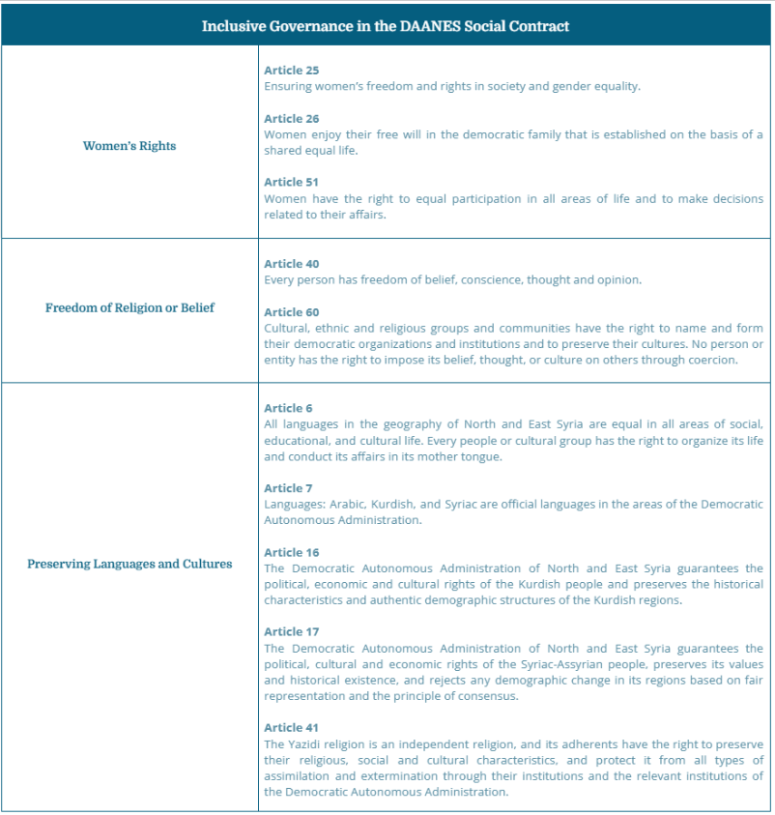
These legal protections were strong because ethnic and religious minorities and women had a seat at the table in writing them.
“During this time, women also directly participated in writing laws and shaping the legal framework of the region, including family law, women’s law, and the social contract. This was real representation, because women were directly involved in making decisions and drafting laws that governed society,” explained a Yezidi woman who served as co-chair of a DAANES institution.
Even the governing structure itself was developed with input from the region’s diverse religious and ethnic communities. A Syriac-Assyrian Christian woman who had formerly served as a co-chair explained that representatives from different communities debated and ultimately voted for the governance model they adopted, recognizing that it would provide stronger and more balanced representation for minorities and smaller communities.
Political appointments made during the integration process are leaving women and religious minorities behind.
While some respected local figures have been appointed to posts in the new government, other positions of power are being given to people from outside of Jazira and Kobane. No nominees from the Kobane Administration of DAANES for the positions of regional administrative director or regional security director were accepted.
The highest-ranking posts offered to former SDF and DAANES figures in the integration process so far – Governor of Hasakah and Deputy Minister of Defense – have both gone to Sunni Kurdish men. DAANES negotiators initially nominated female candidates for these posts, but these candidates were rejected.
So far, the only woman granted an official position in the integration process is Almaz Romi, who was appointed Mayor of Kobane.
No Yezidis or Christians have been appointed to any leadership positions in the integration process yet. Furthermore, many of the leadership appointments made by the Syrian Transitional Government have occurred without consultation with former administrative officials in the region, and many of those appointed are not from the local communities they are now governing.
The government does not accept the co-chair system, meaning that this critical avenue for bringing more women and religious minorities into leadership positions no longer exists.
DAANES officials in Jazira and Kobane suggested that they may move forward with informal alternatives, similar to work-arounds used by pro-Kurdish political parties in Turkey. “As a result, there is discussion around adapting the structure by formally appointing a man as chair and a woman as vice-chair. While on paper this would appear as a traditional hierarchy, in practice they would continue functioning as co-chairs, preserving the principle of shared leadership informally,” said a Kurdish female co-chair of a DAANES institution in Cizire.
Local leaders warn that the current integration process risks undermining the social cohesion and collaborative governance structures developed in Northeast Syria over the past decade. As uncertainty grows regarding representation in governance and security institutions, religious and ethnic communities increasingly feel compelled to advocate separately for their own rights and protections rather than through the more cooperative structures that previously characterized local governance. One local actor cautioned that policies perceived as centralizing power or sidelining minority participation could place increasing strain on civil peace and intercommunal trust in the region.
Minority languages like Kurdish and Syriac (Aramaic) are being erased from public life.
Under the Syrian Transitional Government, only Arabic is an official language. Under the DAANES, Arabic, Kurdish and Syriac (Aramaic) were co-official.
The Christian community has raised concerns that Syriac (Aramaic) has been removed from public signage in Hasakah. This language currently has no formal status under the Syrian Transitional Government.
Kurdish has been designated a ‘national language’ by Presidential Decree No. 13. This status is not legally defined: unlike an official language, a ‘national language’ has no clear place in public administration, politics, education, and other fields. Critics also warn that a decree, unlike a law or constitutional provision, can be repealed at whim.
In addition, the decree limits the use of the Kurdish language in education to twice-weekly elective courses. Kurdish communities prefer bilingual or multilingual education — in which Kurdish and Arabic are both used as the languages of instruction in schools.
Recently, protests took place in Hasakah and Qamishlo when bilingual Kurdish-Arabic signage on government buildings was replaced with Arabic-only signage. An Arabic-only sign on the Justice Palace in Qamishlo was downed by Kurdish protestors and replaced by the government at least three times.
A Kurdish official in Kobane noted that some in the government want to restore the Baath-era name for the city, ‘Ain al-Arab.’ She warned that Kurdish communities would not accept the Arabization of place names – especially in Kobane, where the Kurdish name of the city became a global symbol of the defeat of ISIS.
Yezidis fear erasure, persecution as their religion loses recognition.
Prior to the establishment of the DAANES, the Yezidi community in Syria faced serious discrimination. As one report summarized, under the Assad regime, “Yezidis were unable to identify as Yezidi on their official ID cards, but were registered as Muslims. They were not allowed to celebrate religious holidays, such as their New Year known as Charshama Sor (Red Wednesday), nor were they allowed to have Yezidi religious symbols on their gravestones. They were required to participate in Islamic Studies classes in public school and to swear on the Qur’an to testify in court. They were bound by Islamic Sharia courts in terms of marriage, divorce, and inheritance laws – although Yezidis are not Muslims.”
The community fears that integration into the Syrian Transitional Government will take away the protections for the Yezidi faith and identity that the DAANES Social Contract and institutions offered. Unlike the DAANES, the Syrian Transitional Government does not recognize the Yezidi religion as a distinct faith. Extremist elements of the new army hold anti-Yezidi sentiment.
“My religious and cultural identity is still not formally acknowledged in Syria. Because of this, Yazidi women will face significant difficulties in accessing education and employment, as well as a lack of security due to the presence of extremist religious groups. There is also religious discrimination, including negative stereotypes portraying Yazidis as “extremist” or as people who do not believe in God. In many cases, Yazidis are viewed with disdain by some extremist groups, many of whose members were previously affiliated with organizations such as Al-Qaeda or ISIS,” said one Yezidi woman from Northeast Syria.
“Today, I am worried about what the future might hold under a new political reality where there are perceived Islamist tendencies. I fear what this could mean for my daughter’s personal freedom, education, and identity, as well as for the future of the Yazidi community and other minorities in general,” she continued.
Christian Participation in Governance and Security
Syriac-Assyrian Christians, one of the world’s oldest Christian communities, have been partners in building the Democratic Autonomous Administration of North and East Syria (DAANES) since its inception, participating in both governance and security structures. For many community leaders, these institutions have not only provided representation and protection, but also helped preserve the possibility for indigenous Christians to remain in their historic homeland.
Their communities established their own security forces, which have helped protect churches, Christian institutions, and predominantly Christian villages and neighborhoods across Northeast Syria. Christian security forces have also played a role in the broader fight against ISIS alongside other local forces in the region. During a visit to Hasakah, Syriac Orthodox Patriarch Mor Aphrem II publicly praised the Christian security forces that provided his own protection during the visit.
Many Christian leaders contrast these conditions with those facing Christians in other parts of Syria, where communities report growing fear due to kidnappings for ransom, harassment, and other violence. Christians in Northeast Syria often describe having a stronger sense of security because they are directly included in local governance and community-based security structures.
By contrast, Christians in many other parts of Syria have little or no role in the security services or governance structures operating in their own communities. Christian leaders have repeatedly warned that without meaningful local security participation and representation in governance, many Christians will continue to emigrate from Syria altogether, accelerating the erosion of one of the Middle East’s oldest continuous Christian populations.
“Our greatest concern for the Christian community in particular, as well as for other communities, is migration. We have suffered greatly from this since the 1980s, losing more than half of our community during that time. Since the beginning of the crisis, we have also lost more than half of our community again. If another crisis occurs, we will face a very serious problem, perhaps even the risk of disappearing,” one Christian woman in the Jazira region said.
As integration into the Syrian Transitional Government proceeds, Christian communities in Northeast Syria are closely monitoring developments. Many leaders stress that their long-term future in Syria depends not only on constitutional guarantees, but on continuing to participate meaningfully in both governance and local security institutions.
Recommendations
The U.S. government and international community should urge the Syrian Transitional Government to:
- Preserve the religious, ethnic, and gender diversity currently represented in regional and local governance structures during integration into the Syrian state, including meaningful representation for Kurds, Syriac-Assyrians and other Christians, Yazidis, Arabs, and other minority communities, as well as women.
- Cease unilateral appointments that undermine the January 29 integration agreement. All appointments should be made in consultation with local authorities and representative local bodies.
- Appoint local leaders who are from and accountable to the communities they govern, rather than individuals brought from Idlib’s Salvation Government or from HTS-linked structures with little local legitimacy or trust.
- Protect the use of Kurdish and Syriac languages in public life, including in education, public signage, and government institutions, consistent with commitments to equal citizenship and cultural inclusion.
- Include leaders from the SDF and DAANES – including Kurds, Christians, Yazidis, and members of other religious and ethnic communities — in meaningful leadership and decision-making roles within the Syrian Transitional Government in Damascus, ensuring that national institutions reflect Syria’s full diversity rather than concentrating authority among a narrow group of political or ideological actors.
- Ensure that the future constitution-making process includes representatives of all ethnic and religious communities in Northeast Syria and that those who are chosen to participate in this process are representative of and accountable to their constituencies.
Topics & Regions
About the Authors
Topics & Regions
Explore More
Iran’s Kurdish Alliance Says Their Struggle Will Continue

Related Research
For Syrian Kurds, Mother-Tongue Education is a Red Line

The Coalition of Political Forces of Iranian Kurdistan: Risks and Opportunities
Multilingual Education Will Help Syria Succeed
