
For Syrian Kurds, Mother-Tongue Education is a Red Line

Around the world, each nation lives, speaks, writes, educates, and expresses itself in its own language. The right to use and learn in one’s own language is a legitimate and natural right of all peoples, guaranteed in international agreements on human rights. It should never be up for discussion.
In Kurdistan, sadly, it’s a different story. The Kurdish people have been subjected to assimilation and eradication for hundreds of years. After the division of Kurdistan into four parts, assimilation became more comprehensive. The Arabic, Turkish and Persian languages were forced on Kurds. One of the ancient languages and cultures of this land came face to face with eradication.
At the same time, Kurdish people in all four parts of Kurdistan and the diaspora struggled to defend the Kurdish language. They were able to protect Kurdish language and culture by many different means.
Rojava, or Western Kurdistan, bore the brunt of these policies of assimilation. The Kurdish language and culture were outlawed from the early days of the Baath regime.
At first, the regime banned Kurdish publishing and Kurdish education in schools and universities. Then, with the ‘Arab Belt’ policy, they began to change the names of Kurdish regions, districts and villages and replace them with Arabic names.
This policy wasn’t just a simple change. If one pays attention, it also had the goal of separating Kurds from their history and normalizing the culture of Arabization in the Kurdish psyche.
Of course, speaking in Kurdish in schools and government institutions was also completely banned. Anyone who spoke Kurdish would be arrested. Kurdish workers were fired and left unable to find new work. There are many examples of this and many people who witnessed this policy who are still living today.
I studied for three years in the schools of the fallen Baath regime myself. I’ll always remember how they prevented us from speaking in our own language. Perhaps for children of other nations, schools were a place of knowledge. But for us, it was a shock: in this place, the language that we spoke with our mothers at home was prohibited. When I witnessed this, I was exhausted. At one point, I told my mother that I didn’t want to go to school, because I didn’t know how to speak in this foreign language that they forced us to use and expected us to know.
On the other hand, our teachers would tell us that those who spoke Arabic well could win prizes and gain opportunities. With these policies, they wanted to separate us from our Kurdish language and encourage us to prefer the Arabic language.
Of course, these assimilation policies didn’t bring great results. In Rojava, our mothers always protected the Kurdish language and culture by educating us at home. The Kurdish language has always been defended by hard-working Kurdish mothers. There were linguists, writers, and people concerned with language rights who, in secret, offered Kurdish lessons to small groups of people. Some imams and religious scholars also played an important role in keeping Kurdish alive.
In 2007, in a small village far from the city, a group of activists founded the Kurdish Language Institute (SZK). Under very difficult conditions, in total secrecy, they began to teach Kurdish children their language. They worked with small groups in private homes. Sometimes, it was too dangerous to even allow their students to keep textbooks.
Their efforts continued like this until the Rojava Revolution. In 2012, as the revolution started, the Kurdish language entered public life.
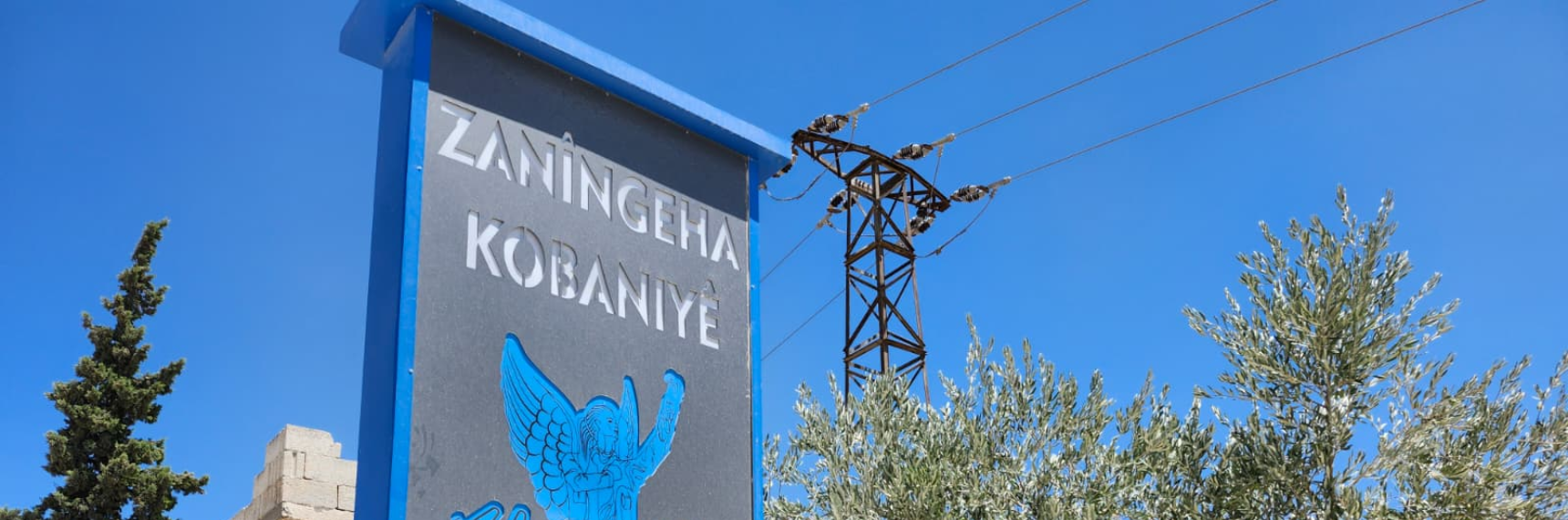
For the first time, Kurdish-language schools were opened. In those schools, Kurdish children were able to study in the language they spoke at home. The first schools and the first university in which Kurdish was the language of instruction were opened in Afrin. As soon as the relevant curriculum was prepared, students were able to study in Kurdish from the primary level to the secondary level. Then, the University of Rojava and the University of Kobane were founded. At these universities, most programs are taught in Kurdish, though some also use Arabic and English.
Today in Rojava, there is a generation that has been educated not just to know their language, but to take pride in it.
When a person is educated in their own language, they can free their mind and advance themselves in all ways. As a journalist, when I speak with students, they say that they are very happy with Kurdish-language education and see their existence and identity in it. Today, some Kurdish students have even begun to write their own books, to notice mistakes in older materials, and to share those mistakes with the relevant authorities themselves.
After the fall of the Baath regime and the arrival of the Syrian Transitional Government, Kurds hoped that the new state would recognize Kurdish as an official language and that all communities in Syria would be able to study and live with their own languages, cultures, literatures and histories.
But it has become clear that the struggle will continue and that a difficult path to constitutional recognition and guarantees for the Kurdish language lies ahead of the Kurdish people. The January 29th, 2026 integration agreement between the Syrian Democratic Forces (SDF) and the transitional government includes two articles related to Kurdish education. Since its announcement, a delegation from the Syrian Ministry of Education has met with Rojava’s education authority. The government has also announced that it will begin efforts to prepare a Kurdish curriculum.
But the government’s position on Kurdish education and the demands of most Syrian Kurds are very different. A Kurdish curriculum already exists. Kurds in Rojava have gone to schools in which Kurdish is the language of instruction for over 10 years.
The government, for its part, wants to offer just two hours a week of optional Kurdish language lessons in some regions. All other educational materials for all other subjects will be in Arabic, like before. That is, they want to return to the days of assimilation and of leaving children to struggle to understand the language in which they are taught before they can even try to understand the subjects they are learning.
The Kurdish people overwhelmingly reject this position. I have spoken with many Kurdish students and their families who say that a return to Arabic-only education is not up for discussion. Kurds are not willing to go back to the pre-2011 status quo. They have become accustomed to living with their history, literature, culture and language and approach this policy question from this perspective. They know that if they give up the right to mother-tongue education, they will end up without status: a people who lose their language will soon find themselves without a nation.
Kurdish as a language of instruction from preschool to university is therefore a red line. The equal and official status of Kurdish must be guaranteed in the new Syrian constitution. Kurdish-language education and diplomas granted by the Autonomous Administration must be recognized. The new curriculum must approach Kurdish issues from a perspective of equality, so that Kurdish children — like all children from all communities in Syria — can learn about their own culture, literature, art and history.
It is important to recognize that these are not special requests. They are rights guaranteed in international conventions and realities of Syrian Kurdish society. Kurdish rights are the cornerstone of democratization in the new Syria. Without Kurdish participation, peace and social cohesion will be impossible.
If the government insists on its current policy, one thing is for sure: Kurds will not let go of the right to our language. Today in Rojava, Kurdish children start the school day with the words “Be ziman jiyan nabe” – that is, “without our language, there is no life.” Our people will not accept a life without the Kurdish language or one where it is reduced to second-class status. This is a basic human right and our red line.
Topics & Regions
About the Author

Explore More
My city defended the world from ISIS. Why is it still under siege?
Related Research
Multilingual Education Will Help Syria Succeed

The SDF-Damascus Deal and the Kurdish Question: Prospects for Peace
Iran’s Kurdish Parties Work Towards Unity as Protests Escalate
