
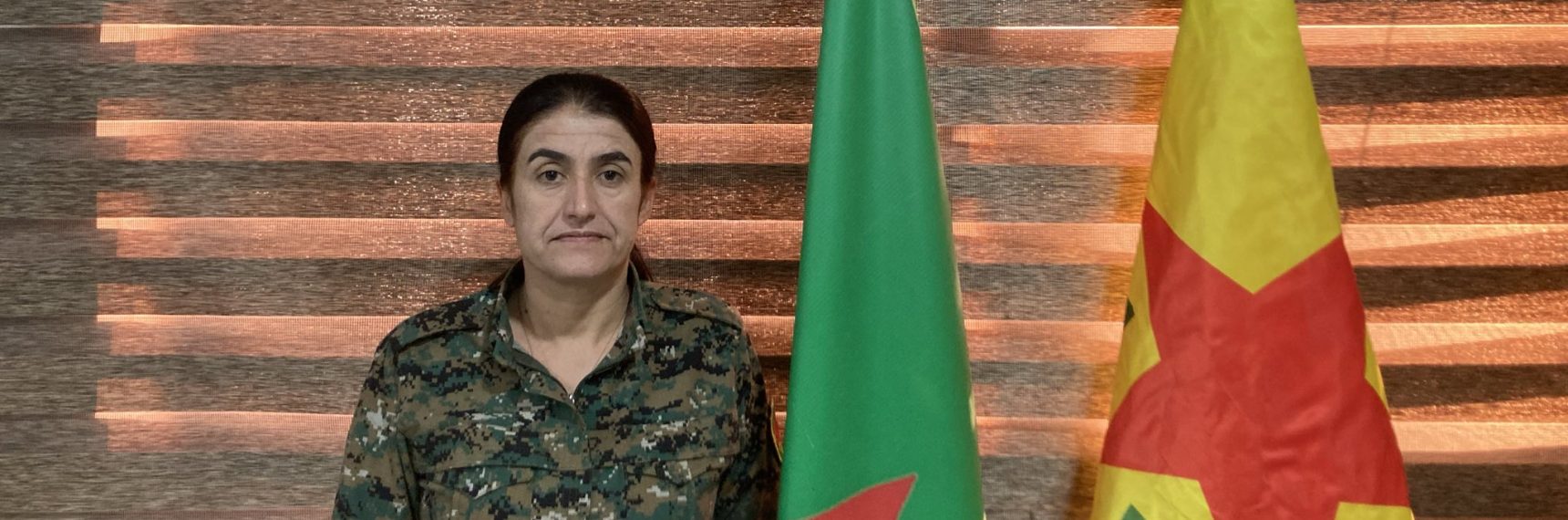
Rohilat Afrin: “We are at the table because of our own achievements”
- This interview is a product of the Kurdish Peace Institute in Qamishlo, which provides decision-makers and the public with locally-rooted, actionable information on critical issues facing northeast Syria, the region, and the world. The interview has been translated from Kurdish and lightly edited for clarity.
Kurdish Peace Institute: Thank you for your time and insights. Can you introduce yourself and explain the role that the Women’s Defense Units (YPJ) play in the Syrian Democratic Forces (SDF) and in North and East Syria in general?
Rohilat Afrin: I am Rohilat Afrin, General Commander of the YPJ. I am also a member of SDF General Command. The YPJ has been around in some form for nearly thirteen years, that is, for the entire length of the Rojava Revolution. If we want to speak officially, the YPJ has existed for the past 11, 12 years.
The YPJ became a part of the defense of our society. For the first time, a women’s army was able to stand up to an invading, oppressing force. Because the YPJ predicates itself on the concept of self-defense, there was no societal reaction against women’s participation in the armed forces. This society has always needed the capacity to defend itself. If we look at history, the Kurdish people, and the people of Syria, have gone through many wars – but no force that could take responsibility for the defense of their land and their country ever developed. Certainly, people went and became soldiers. But military service separated them from themselves, their land, their cause, their society. They served the regimes under which they lived.
The YPJ is important as an armed force, as a model, and in the sense of its impact on society. Because the most fundamental necessity for women all around the world is what? It’s self-defense. The YPJ first organized itself around this idea and principle, not around weapons. We chose self-defense as a goal with belief in our knowledge and capacity as women.
The existence of the YPJ in Rojava, in northeast Syria is a breath of fresh air for all suffering women in the 21st century. Not just for Kurdish women, not just for women in our region, but for all women. In a very short time, our model, our army, and our ideas became known in many foreign countries. We were never in America. But our perspective has reached America. We weren’t in Europe, but our perspective reached Europe. We weren’t in other parts of the Middle East, but our perspective has spread across the region. In the 21st century, it became clear that women, and society, needed something like this. This necessity reached all women.
Our Kurdish society had some experience with this. Many of our friends, neighbors, relatives had gone to fight, for example, with the YJA-STAR [the all-female armed wing of the PKK]. This existed. We opened our eyes to it in this way: Where did this woman go? Why did she take up arms? I can say that the level of women’s military organization in Kurdistan had an impact on us. Especially, we saw that each woman who left home to fight, who went to Iraq, to Turkey, did so to defend all of Kurdistan and all Kurdish people.
With its motivation, its philosophy, and its self-defense perspective, the YPJ was able to slam the door shut on a group like ISIS during the longest and darkest years of war in Syria. ISIS seemed unstoppable around the world. But here, a struggle waged under the leadership of women was able to defeat ISIS. This isn’t something normal. Maybe we have gotten used to it, because we live in this reality, it’s a part of who we are. But elsewhere, it became a story, a legend, a topic of interest. How did those women achieve this? I can tell you how.
We, as the YPJ, did not start with weapons. I want to emphasize this fact. We started with organization. Our greatest weapon at the very beginning was our organization. From two, three, four women, we became hundreds and hundreds.
In the beginning, we said that we women had to be there, in the armed forces. We’d see ten men, twenty men, the whole military academy, and among them we would be maybe four or six women. There were not many women at all. But we had this belief that women had to be there and do this work, we as women had to join. And when society saw that we had a goal, that we would do anything to fight to protect our land, our people, our families, they began to support it.
So, I can say that the YPJ, both as an army and as a philosophy, reached this level with its capacity for organization. If it didn’t have this organizational force, if it didn’t have a philosophical and theoretical foundation, and it hadn’t chosen the right leaders, then perhaps it couldn’t have become the army it is today. These things are fundamental. To become an army, you need an objective and an organization. In the 21st century, women everywhere are learning how to defend themselves from the YPJ. We became an inspiration for all women, not just the women of Kurdistan, Rojava or Syria. In every time period, peoples and societies have some kind of need and leadership develops to meet it. Now, we can say that the YPJ is playing this role for women.
Can you give a specific example of the impact of all-women’s forces on security, governance or society? That is, what are some things that the YPJ does that male or mixed units couldn’t do or wouldn’t do as well?
I will tell you a story I have shared many times. We opened our first women’s academy in Afrin. We wanted women to learn how to defend themselves in every capacity. In the program, for example, we said that women would have to exercise to learn their physical strength. Women had to learn their mental strength, too, through political and ideological education. And third, there would be military education. They had to learn to use the technology that would be in their hands. Never once did we think of starting with weapons. Before taking up arms, women had to understand politics, ideology and philosophy.
We brought together a group of 30 or 35 women. Among them was a mother who might have been 50 years old. She was from Amude. At first, we discussed among ourselves whether she would be able to participate in all the activities of the academy. We spoke to her and said that we would have to reject her – the program was difficult, conditions at the academy were harsh, and we were worried that it might be too much for her to take. Of course, she taught us a lesson right there. ‘Who are you to kick me out of this education!’, she replied.
Philosophy tells us that the first thing you must do is know yourself. This mother, who asked us who we were to stop her, who said she too wanted to learn to fight, knew who she was – and she gave us all a lesson in self-defense that day. She said she wouldn’t leave the academy until she learned how to use her weapon, and with that determination, she didn’t. Our strength and organizational capacity as the YPJ comes from women like her.
Self-defense is the most important part of civilization. It is not only necessary when a society is at war. Threats come from nature, animals, from other people, anywhere – you have to be able to protect your society from any danger. Today, we see that the least protected people in society are women. Women face domestic violence, rape, inequality, and they are belittled when they ask for an end to the injustice. Some attacks on women might not be physical, but the basis of physical violence is the idea that someone is lesser. If your rights, your body, your language, your culture, your opinion is denied and ignored, you may be attacked.
The YPJ has upended that status quo. We say that wherever a woman faces violence – in her home, from criminals on the street, from the mentality denies women equal humanity – she must be able to defend herself. We started our work on this basis. And of course, ultimately, if there is an attack from a foreign enemy, she must take up arms and defend herself too. Before, women might have left their homes and communities, left this region, and gone to other parts of Kurdistan to fight. Maybe their struggle didn’t have as much of an impact on the community at large. But the YPJ is different. We defended our society from within it. We didn’t wait for anyone to come from outside and save us. And of course, if this wasn’t connected to an ideology, and an objective, it wouldn’t have been possible. This connection, this basis, is why no one has been able to destroy our organization in 12 years. The role of the YPJ became apparent for the first time in the war against ISIS and has continued to this day.
The fall of the regime in 2024 and the arrival of radical Islamist forces made everyone ask: What is the future of the YPJ? Not just the YPJ – the people, all of North and East Syria, the autonomous system here. How could we live under their rule? Two very different systems have now come face to face with each other in Syria. One is a harsh, fundamentalist system. The other, our administration, is based on the will of our people.
As you describe it, Syria is now split between two very different political systems. These two systems have been working to come together under the framework of the March 10th, 2025 integration agreement signed by SDF commander-in-chief Mazlum Abdi and Syrian president Ahmed al-Sharaa. In general, how are integration talks progressing? What is the role of women and women’s structures in them?
A year has passed since the fall of the regime. There have been many changes in that time. Once again, innocent people became the victims of war. It’s been a year since the displaced people of Afrin were forced out of Shahba, for example. The state is not so impacted. When people are attacked, killed, forced to migrate, the state does not listen.
Now, the biggest question is this. The force that now dominates Syria has a past as a radical entity that devastated and oppressed innocent people. It comes from jihadism, from al-Qaeda. From there, where has it gone and where will it go? How did it come to power? Who supported it? How has it become so legitimized? We need to understand this. Though of course, when any force becomes a state, no one pays much attention to what it may have been before.
60 years ago, a centralized system was created in Syria. The Syrian people suffered in every imaginable way because of this system. Now, with the arrival of Sharaa’s transitional government, we must look at this history. The international community can also evaluate the situation. From our side, as North and East Syria, SDF and YPJ, we’ve engaged in many dialogues and negotiations. The most important result of these engagements was the March 10th Agreement. This agreement was reached on the principle that this society, this component, its language, its culture, its rights, and its existence will be recognized in the constitution.
The most important guarantee for any society is constitutional rights. If a community, people, language, or component is not recognized by the constitution, its existence in its country is under threat. If you have no presence in assemblies and parliaments, you don’t exist.
There have been many changes in the 21st century. The transitional government itself doesn’t hide what it used to be. First the Islamic State, then Al-Qaeda, al-Nusra, then HTS, and HTS came to become a government, a state. That’s a change — and it is a change that cannot be merely cosmetic. The world must believe it. If they want to move away from such a dark history and become the representatives of a republic, then they have to recognize the rights of all components.
For thirteen years, we have waged this struggle. Many people have given their lives. We can say that there has been a change, that the old system was destroyed, but that itself isn’t enough. We are ready to live in a unified Syria, but it must be a democratic Syria. This democratic Syria must protect the rights of all its peoples — Kurdish, Arab, Syriac, Muslim, Christian, Druze. And the best guarantee of this protection is the recognition of all components in the constitution. Integration starts from here.
At the beginning, they said that each SDF soldier ought to join the army one by one. But the SDF can’t join this army as individuals. We said to them, alright, we’re ready to join the army, but what army do you want us to join? Is there something called an army in Syria? No! There are more than 100 militias. Everyone forms his group and gives it a name. Abu Amsha has a militia, Abu Shaqra has a militia, Hamzat has a militia. Can you call that an army?
In all of Syria, the one army that has a structure, experience, and capabilities is the SDF. For thirteen years, this force fought against ISIS, against outside powers that attacked us. We say that the SDF can be a model for a Syrian Army. Why would that hurt Syria? It won’t harm the unity of Syria at all. The SDF is here today, but tomorrow, we could protect Damascus. We could protect Aleppo, Suwayda, or the coast. The SDF model can be a model for the new Syrian army. When we say this, we aren’t saying that Syria ought to be divided or that we want to live separately. We don’t say that we have to be independent. What we are asking for is a democratic Syria that recognizes the rights of all its components.
As for integration, we started out together, but we haven’t yet reached an agreement. Recently, there were some discussions about how we might organize ourselves as part of the new military. But the fundamental matter is constitutional guarantees. When we have that, we can talk about the SDF, our institutions, everything.
The time that we’re living in requires everyone to change themselves. In Syria, the old system fell. We don’t live in the pre-2011 era anymore. When Assad was in power, he had a centralized state. That state was destroyed. If the same centralized system tries to rebuild itself in a different color, that isn’t real change.
All this is to say that yes, negotiations are taking place, but we haven’t yet agreed on practical steps to take together. On the table, everything is approved, but once we get up from the table, the situation remains as it was. We see this in particular from the transitional government’s side. Let me repeat this: our objective is not the division of Syria. Our objective is a democratic Syria. If you look at the SDF, you will see that it built an army that includes all components. The YPJ is like this too. Women from all Syrian components have joined the YPJ. We can put this experience at the service of all Syrian society. For example, when ISIS was in Deir Ezzor, we didn’t say ‘Deir Ezzor is an Arab region, we won’t go there.’ We fought ISIS wherever it went and gave thousands of martyrs to do so. Raqqa isn’t a Kurdish city either. Our forces, our ideas, and our objectives united people from all components and we protected all of North and East Syria together.
You said that some points have been discussed in integration talks but not yet put into practice. We would like to ask about the status of the YPJ in this context. Some sources have claimed that the transitional government is open to allowing the YPJ to join the army as a special brigade. Other claims suggest that the U.S. has backed the SDF’s position on YPJ integration. Are these claims accurate? And what can you share about the YPJ’s conditions for participation in the new army?
From the fall of the regime until today, Coalition forces have played a mediating role. No one can deny this. Many dialogues took place with their mediation. But we are at the table because of our own achievements. Our successes, our strength, and our force, the effort of this society – without that, we wouldn’t be in these negotiations. For years, we have had a relationship with the Coalition in the context of our joint fight against ISIS. This has created real friendship and understanding. But the achievements of this revolution were what brought us to the table.
We, as the YPJ in particular, are present in negotiations because of what we have accomplished. Everyone told us that it wouldn’t be possible, that they wouldn’t accept us. But we aren’t negotiating in our personal capacities. We bring the gains of a revolution with us. Those who sit across from us can see that.
For this reason – and maybe I’ve said this before – change is a condition of our time. This regime has to change itself. Now, everyone is asking us if we have been accepted because we are at the table. Without this experience, these achievements, we wouldn’t have even made it into the room. We don’t believe we deserve to be at the table just because we’re women. But if we are a part of this revolution, then why wouldn’t we be a part of negotiations? We have participated from the beginning to the end. This is a perfectly natural right.
I don’t want to get into the issue of brigades and divisions, because that is a conversation, not an agreement. It wouldn’t be appropriate for me to say anything concrete now. But we have put forward the idea that the YPJ should maintain its autonomy. Today, we aren’t even fully integrated into the SDF. Of course, when there is a general interest, if this land is under attack, we will work together to serve our people. But otherwise, we have our own command, our own centers, our own institutions, and we organize and educate ourselves within them. In this way, we protect our autonomy. The ones who make decisions and institutional changes in our forces are the Women’s Command. SDF General Command can’t change this. General Mazlum might be the General Commander of the SDF, but he can’t force me to do anything. He can’t make a change in our women’s forces or send me to a different position. Who can do that? The Women’s Command. This means that we protect our autonomy and freedom. Everyone has to know this.
Our view as the YPJ is that we must defend this status. We must have a place in the military system. We organize both horizontally and vertically. For example, we also have a social force, we organize in civilian life, too. We exist as an autonomous force within the SDF structure, but there are women in non-YPJ SDF units as well — it isn’t an army for men only.
For thirteen years, we have defended this country, but no one in Homs or Hama or Suwayda or the coast had heard of us. Everyone outside of Syria, in the U.S., Russia, Europe, knew that the YPJ existed — but unfortunately, within Syria, Syrian women didn’t know us. But now that the regime has fallen, women in all parts of Syria can see us, and many want to organize themselves like we do. So, the YPJ will protect itself as an autonomous women’s force in northeast Syria. When we reach an agreement with Damascus, the YPJ can play a role for all of Syria. But we will keep our special status. We won’t give up our existence and our organization. The need for self-defense doesn’t go away just because we are approaching peace. Maybe we won’t deal with the same enemy again, but there could be attacks. One has to be ready. Especially women – women cannot afford to do away with the capacity for self-defense, not in wartime and not in peacetime. This is our view as the YPJ.
You have participated in integration talks with Damascus yourself. Many senior transitional government officials come from a radical Islamist background, while you represent a radical movement for self-determination and women’s liberation. How do they approach you and other women leaders from the DAANES and SDF delegations? Do you think the experience of negotiating with women from the DAANES and SDF might be changing their view on women’s roles in the new Syria?
They are trying to change their image. As a result, when they engage with us, nothing unusual happens. It’s all within normal protocol. When we greet them, for example, some shake hands and some don’t. From this, you as a woman can understand that they come from a rather strict background. Ultimately, though, there is a very pragmatic approach that has an impact on the discussions and the overall situation. You can see a softening in their rhetoric when we discuss issues with them. But in practice, when nothing changes, you can see their radicalism. They have made many requests of us that we have fulfilled. Most recently, on the matter of military integration, we presented them with names and ideas. In the media, they accuse us of holding up talks. But in reality, they are the ones who slow-walk negotiations and refuse to answer our proposals.
If this government can believe in the existence of all of Syria’s faiths, languages, and communities, if it can realize that this pluralism exists, then Syria can be a democratic country. Many Sunni Arab Syrians, who are the majority of the country, do not accept this exclusive mentality either. It isn’t just an issue for religious or ethnic minorities. If the transitional government can change itself and accept the realities of the 21st century and the needs of society, Syria will live in peace. If it can’t change, it will only see greater crises.
I will say something important here: this government is not completely independent. There are many foreign countries that want to have an impact on integration talks. I don’t want to name them here. If Syria to be a country for all Syrians, these foreign forces should stop trying to influence negotiations. Let the transitional government share its own opinions, free from the influence of outside views. It’s clear that the government is under pressure from foreign forces. Without this, an agreement may have been easier.
We [the predecessors of the SDF and the transitional government] fought against each other in 2012, 2013, but today we’re talking. This isn’t something new in the world. Those who fight the most brutal wars against each other unite to make peace.
In many European countries, like Switzerland, many peoples live together, and each people has its rights. Sometimes they might number less than a million, but they get their rights just the same. Why couldn’t Syria do this? What harm would it cause that makes it impossible? This government needs to listen to the voice of the people, not to foreign influences. In this way, we can build a peaceful and democratic Syria together.
Many people here say that Jabhat al-Nusra would refuse to speak to YPJ fighters during the 2012-2013 clashes and negotiations that you alluded to; they would reportedly demand to negotiate with men instead. What can you tell us about that?
Yes, it’s true – back then, they didn’t want to talk to us. Now, because of everything that has changed, they have to.
But you know, even in 2012, when I was in Afrin, I sat down with them on more than one occasion. It was hidden, of course, but we had dialogue, though in the end they would prefer to talk to men.
Do you have anything else that you would like to add?
In any country, revolution, or peace process, if women aren’t present, then a solution isn’t possible.
Our revolution proved this. Women who couldn’t leave their houses without permission can now do politics, diplomacy, cultural work. This freedom didn’t exist before. But our mindset and our system created real confidence and belief. Women’s leadership is the aspect of this revolution that drew the most interest. Both in war and in diplomacy, if organized women aren’t present, we won’t reach a solution.
The 21st century will be the century of women, and solutions to its problems can be found with women’s leadership. In a place where women can organize and lead, success is possible. But places where women’s existence, voices and opinions are denied are headed towards destruction.
Our revolution has reached a certain level today. Many things could change tomorrow. It might exist under a different name or a different system. Our objectives won’t change, but many things that have existed until today could look very different. Because this process, this time, this century is a time of change. But what is important is that we don’t deviate from the path of those who stood up for democracy, pluralism, and all of our values.
Photo: Kurdish Peace Institute
Topics & Regions
About the Authors
Explore More
The Coalition of Political Forces of Iranian Kurdistan: Risks and Opportunities

Related Research
YPJ Integration: What are the Obstacles?

My city defended the world from ISIS. Why is it still under siege?

Multilingual Education Will Help Syria Succeed