
Sose Sarkisian: “We exist, with all our faiths and languages”
This interview is a product of the Kurdish Peace Institute in Qamishlo, which provides decision-makers and the public with locally-rooted, actionable information on critical issues facing northeast Syria, the region, and the world. The interview has been translated from Kurdish and lightly edited for clarity.
Kurdish Peace Institute: Can you introduce yourself and give our readers some information about the Armenian Women’s Unit?
Sose Sarkisian: I am Sose Sarkisian, an Armenian woman living here in northeast Syria. I joined the revolution here when it began in 2011. I took part in both military work and civil work.
As Armenian women — wherever we are needed, not only here in Syria — we will go there to support that revolution. We have many historical figures to look up to and we have gone through so much suffering. When our elders would talk about the genocide, we felt their pain. Until today, when we see the Turkish state’s enmity towards us, we remember our families. We feel it even more. But our pain gives us the strength to resist.
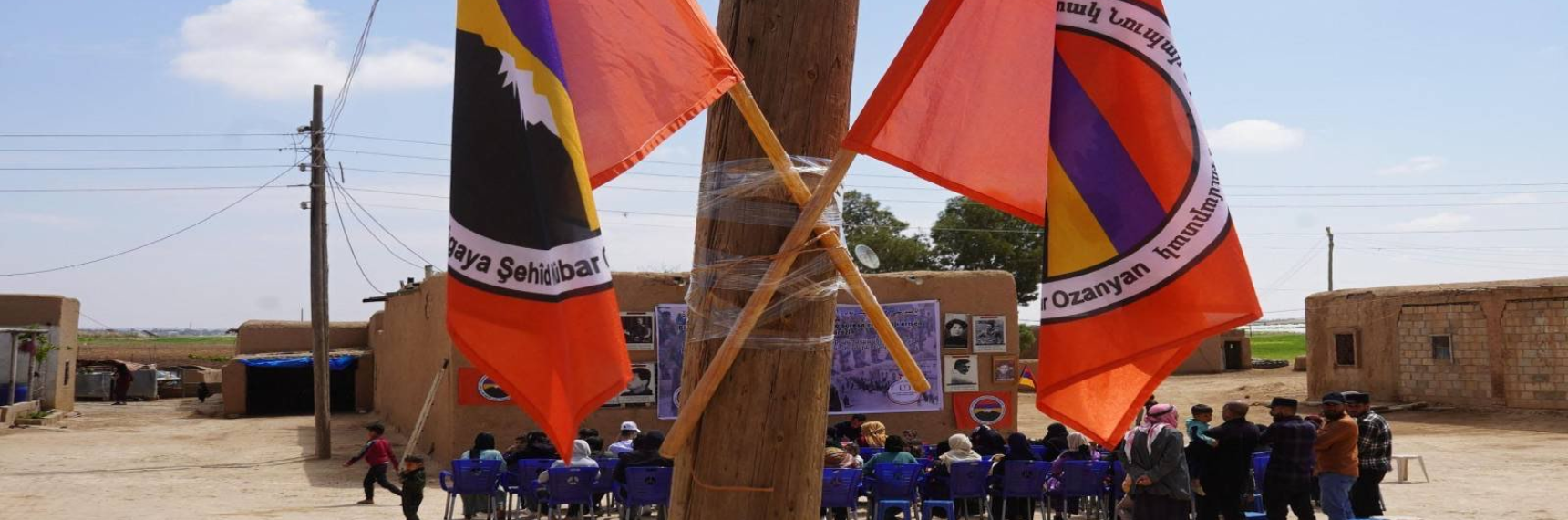
We established this group in 2019. It is an autonomous Armenian women’s unit. We have 35 members now. We also have positions in the Armenian military structure within the SDF [the Marty Nubar Ozanyan Battalion] and the General Commands of the SDF and the YPJ. As Armenian women, our aim is to create a place for ourselves in Syria. We have made a great effort and given martyrs. Maybe our numbers are small, maybe you can say that there are few of us, but our strength is greater than our numbers.
We offer political and historical education and teach the Armenian language. Just like our Kurdish comrades want to liberate all Kurdish people, we as Armenians want to liberate all Armenian people. Part of our land is still under occupation, too. We also want to return to our homelands. It isn’t just the Kurds and the Arabs in Syria who have been oppressed — Armenians are oppressed as well.
Many people come here and ask us how we have become so courageous, where our morale comes from in the armed forces and in society. No one has seen what we have seen. Certainly, there have been genocides all over the world, but the Armenian Genocide is in a category of its own. We are still impacted by it to this day. Whatever happens, we can never forget. Maybe the older generation is leaving us, but we make sure our children remember.
An enemy can never be a friend. Look at Abdullah Ocalan. No matter how many steps he takes for the Kurds – he’s taken three steps so far, for Turkey and Syria, this is the third step that has been taken — the Turkish state does not take a single step in response. And we’re hopeful that they will take a step? Anything Turkey is doing, it does for its own profit, not for the people. This is what a capitalist nation-state is. It will sell the entire world just to enrich itself. Like Bashar al-Assad. After 24 years, he took everything he could from Syria and left in hours. He didn’t think about Arabs, Kurds, not even his own sect [Alawites].
Every group that became prominent in Syria – the FSA, al-Nusra, ISIS – attacked us. We as the YPJ, as Kurdish, Armenian, Syriac-Assyrian, and Arab women, resisted. Once, in 2023, I went to one of the camps and spoke to one of their [ISIS-affiliated] women. She told me, ‘Did you know what we were most afraid of? When we heard women’s war cries on the battlefield. When we heard women’s voices, she said, we knew we would lose. The enemy knows how strong we are. No matter how many attacks we face, we will resist.
We have the same attitude towards Turkey and their proxies. They took our cities – Sere Kaniye, Gire Spi, north Aleppo. What’s the difference between them and ISIS? Until now there are ISIS members among them. They didn’t come here for the people – Turkey doesn’t do that. Turkey didn’t come here to do anything for Arabs, Kurds, Armenians, anyone. We have no faith in them. Sure, perhaps Abdullah Ocalan has given them an opportunity, has taken some steps. But we don’t trust the Turkish state.
On that note, we, as Armenian women, have organized ourself in line with Ocalan’s ideas. We were inspired by Kurdish women’s struggle. When I joined this revolution, in 2011, no one knew what to do with a weapon. My family had no interest in weapons. As Armenians, we are not anyone’s enemies. Although we faced genocide, we never took up arms against anyone – in my view, that was a mistake. If we can defend ourselves, we won’t be subjected to genocide again. We are people who want peace, we don’t want more war – but we were subjected to massacres.
In 2011, 2013, I was very interested in military work. Mothers were in pain. As a mother myself, it was difficult for me to join the fight. We had martyrs from our community, from among my friends. Comrade Medya, Sehid [martyr] Medya, she was with us. I’ll never forget the pain when she fell. I knew Hevrin Khalaf, too, from our civil administration. We were together for three years in political and economic work. You know what happened to her — so, how can I lay down my weapon? If I am not a comrade of these women, if I don’t spread the values that they stood for, then I will have committed betrayal. Five of my children are fighters too, now. Our martyrs did not die in vain. We’ll resist for so long as we draw breath.
We want freedom and peace. We took up these arms to say to our enemies, in the language they understand, ‘enough with the killing,’ ‘enough with the massacres.’ We took up arms to protect ourselves and our homeland. What was the sin of these women, these children, these young people forced from their homes? There is so much pain here in northeast Syria. Our friends were killed, injured before our eyes. In 2013, 2014, we didn’t even have medicine. There was a blockade on our region from the Syrian side and the Turkish side. We couldn’t bring the most basic medicines in. We lost many comrades because we couldn’t treat their wounds and illnesses. Do you understand what that means? We were caring for them in the open, under trees, with nothing. It’s hard for me to tell you about even now.
As women’s forces, all of this makes us stronger. No matter how much pain we feel, we will resist. Many people said that the YPJ would be destroyed if there were a serious attack, like ISIS. But who were some of the most advanced forces in the war against ISIS? In this revolution, some of the most advanced forces, politically, socially, and militarily, are our women. Women are like our land — patient and strong. The strength of this land and the strength of women are the same thing. The land establishes everything upon itself, and so do women. There is only one thing we don’t accept: we don’t accept injustice. We don’t accept oppression. We embrace everything else, we can live with everything else, we claim and take care of everything else.
All peoples joined our revolution. We walked together like brothers and sisters. Our Kurdish, Arab, Armenian, Syriac, Turkmen comrades – we were many peoples all together on the same front line. We wouldn’t say, look, she’s Christian, she’s Muslim, no. We defended each other. Our revolution succeeded because of this. We accepted all peoples and all nations. It wasn’t done for just one language or just one flag. Because of this, it succeeded. We can establish a free Syria on this basis, a Syria for all of its peoples. We hope that this will come in the near future.
We also hope that this will happen. These days, the integration of northeast Syria with the transitional government in Damascus is on the agenda. Some leaders in northeast Syria have claimed that the SDF will join the new Syrian army as brigades and divisions, one of which will include the YPJ. How do you evaluate the integration process so far? And what conditions do autonomous women’s forces have for joining the army?
Some meetings have taken place, that’s right. But there is no integration to speak of yet. Integration needs time, education, work. Can a democratic mentality and the mentality of genocide work together? No! They kill, they steal, they assault women – how can we believe in them? Our situation is like what Abdullah Ocalan has done – he takes three steps, and the Turkish state does nothing. It’s the same for us. Eight months have passed since the agreement between Ahmed Sharaa and General Mazlum [Abdi]. But in that time, nothing has been accomplished. We know where this Ahmed Sharaa comes from. We as women don’t accept him or his army. Should we forget our people in Shengal [Sinjar], our comrades here in Rojava, the Yezidi women who were kidnapped and sold? Until now, Yezidi women are still missing. He and those around him were involved in these crimes.
On social media, in the media that is opposed to us, they are always saying the YPJ will go away, the SDF will go away, Ahmed Sharaa has taken his place. But the SDF and the YPJ are still here. The March 10th Agreement hasn’t been implemented yet. Maybe both sides agreed upon some points, but that hasn’t been realized on the ground. Just as Turkey refuses to take steps in their process, Damascus does the same thing. The issue is the same on both sides of the border. Here, an agreement was reached, our side took some steps, and their side did not respond. Our opponents never take steps because they are afraid. They know that if they take these steps towards a more democratic system, they will fail. And if they don’t, they’ll still fail.
In January, KPI spoke with leaders in the YPJ. They raised the same point about the vast difference in perspectives between the two sides in these integration talks. I want to ask you a bit more about North and East Syria’s perspective on women’s inclusion. Why do you place so much importance on women’s organization and women’s self-defense? And how would you evaluate the ‘women’s revolution’ today – what has succeeded, what shortcomings still exist, and how will you continue this struggle in the new Syria?
This revolution is fourteen years old. As the YPJ, our perspective is important. We cannot and will not give up. Our situation today is nothing like our situation in 2011. We’ve become stronger. In this revolution, with the effort of our martyrs, with our philosophy and theory, we have made the greatest progress. We as women are hopeful that women will take their place in Damascus. We hope that we, as the YPJ, we can take our place in Damascus too and defend women across Syria. I personally hope and believe that a woman could be the president of Syria someday! Maybe in 2011, we didn’t have this practical experience. But today, we’re more advanced, we as women know ourselves. The future is very open for us. We have learned all methods of struggle.
Today, children see us in our uniforms and are happy. They say that they’d like to join the YPJ and be like us when they grow up. What does this mean? It means that they know we represent freedom. We freed ourselves. We established ourselves. We did it all in face of oppression that perhaps no one else in the world has seen. Our women were assaulted, killed, targeted in every way. Today, we say that wherever a woman is oppressed, we will take responsibility for her. A woman can free herself with just her own voice. To understand and say ‘women, life, freedom’ – that’s enough.
In the beginning, we didn’t understand what freedom was. Yes, we knew that women had joined the revolution, that they worked, they did this or that, but slowly we learned how to be free. Establishing each free personality was like creating a new world. I hope that one day, a woman will be president of a free, democratic, pluralist Syria. In this country, we can’t say that there’s just one flag, just one language, or just one history. We have dozens of colors, hundreds of languages. The whole world should see this. Look, European states say that they are democratic, that they’re free, but they are not free. If you look at the U.S. or Germany, they say they’re democratic, they say their women are free, but this isn’t freedom. People leave their land here and go to Europe thinking they’ll be free, but they don’t know what freedom is. Here, in this revolution, women have created freedom. How could we ever accept oppression again?
As the YPJ, we are sometimes outside of society. Perhaps our comrades who do civil work know the pain and struggles of society better. But these women are making progress too. Where did they get the strength to do that? From the YPJ. When our forces would go through a place, people would see us and ask, ‘How do you fight? How do you speak in front of men?’ They were afraid, somehow. They almost couldn’t believe we were real.
Slowly, we educated our communities. We would go sit with a family and speak with the men, too, not just the women. Sometimes, I run into men who were very suspicious of our work at first. Now, women in their families participate in the revolution as well. Some men even come to us now asking if we have a place for the women in their families – ‘My daughter wants to join the YPJ’, or ‘Do you have a civil job for my wife? It would be good for her to work.’ This happened in all of our communities – not just among Armenians or Kurds. For the Arab community, in areas we liberated from ISIS — they were especially suspicious at first. Many of them saw it as shameful for a woman to speak with men, to join political work, to fight on the front lines. There was an expectation that women would just stay at home. Now, we [the DAANES and SDF] go among them and they ask us, ‘Can we come work with you?’
Where did this change come from? This came from the YPJ. The YPJ built this revolution. This project of fourteen years was built with the blood of our martyrs. I’ll give the example of Arin Mirkan. She sacrificed her own life so that her comrades, men and women, could fight on. She died so that our people in Kobane could live. We have paid the greatest price there is for freedom. How could we go back to being slaves?
Ocalan says that when a person has tasted freedom, when they know what it is, they can never go back. This is what happened here in our revolution in northeast Syria. You can oppress an oppressed person, maybe, but you can’t oppress a free person. Someone who knows that they have rights won’t give those rights up for anything, to anyone.
On that note, the transitional government has claimed that it wants to create a Syria for everyone. But at the same time, we have seen campaigns of sectarian violence targeting the Alawite and Druze communities. Many people fear that the same thing will happen to Kurdish, Christian, and Yezidi communities in northeast Syria in the future. In your opinion, what has to happen for Syria to truly be a state for all of its components?
For a country to truly be united, it must include and protect all its people. That is what a free Syria would be, what a democratic Syria would be. We say to all Syrian women, not just those in the northeast – let’s join hands. Wherever a woman cries out for freedom, we want to be there for her. Not just in Syria – wherever in the world women are oppressed, we want to reach them. We hope that all Syrian women will organize themselves and show their strength. We’ve sent humanitarian aid to other parts of Syria, we are getting to know each other.
You’ve been here in the spring. How colorful are the flowers here? Can you reduce them to just one color? No! Syria is just as bright. Our spring will come, with all our colors and all our peoples. These past few years in Syria, there has been no rain. There have been massacres and attacks. Blood, not rain, has watered our soil. From this blood we’ve shed over fourteen years, the freedom of our society will grow, just as the spring flowers grow when the rain finally comes.
Whatever our enemies say, we exist, with all our faiths and languages. We took up arms for our freedom, and we won’t lay them down without it. Erdogan and Sharaa say, ‘there is no YPJ.’ We tell them, we’re here. Our resistance, our martyrs — these are no small things. A free Syria, with all of its colors, all of its languages, all of its peoples, must be established.
Erdogan, Sharaa, the U.S., France, Russia, every country that has come to Syria – they know what we are. Many states came here. We know who what they are too — they came for their interests, not for us. At the end of the day, we don’t lean on anyone. In Afrin, in Sere Kaniye, they left in hours. Who was it that stood with our forces? The families of the martyrs. Each family here in northeast Syria has lost maybe ten people, at the very least. That is who is behind the YPJ and the SDF, not any foreign power. They say that the mountains protect the PKK guerrillas. Here, in northeast Syria, our people are our mountains. Our project has no foreign agenda; it comes from our people. As an Armenian woman and as a member of the YPJ, I say this: we depend on our families, our society, the mothers and fathers and brothers and sisters of our martyrs, not on the U.S., Russia or any foreign agenda.
So, governments have interests that can converge and diverge, but this project has a social base that should be accounted for?
Yes, that’s it. Our base is our people, our martyrs, our families.
Your military forces are part of a larger project of organizing the Armenian community here in northeast Syria. What can you say about those efforts, and what do you want the Armenian community around the world to know about your work?
I’ll repeat this – we took on this revolutionary work in the shadow of the Armenian Genocide. I am a mother. It’s impossible to put that aside. But to ensure that our people would not face more massacres, I had to join this work. As the Armenian community, throughout history, we focused on ourselves. We never caused any problems for our neighbors or attacked anyone. And yet we were subjected to genocide. Our neighbors attacked us.
As an Armenian woman, I call on all Armenian women to develop and strengthen themselves. Look and see what we have done in Syria, how we’ve developed ourselves here. We have rights, we fight for our freedom as women and as a people, we defend our community on the front lines and organize our society. Before, maybe people asked if there were Armenians in Syria, and others said, no, there are no Armenians in Syria. This was the Baathist system. We didn’t claim our identity so much, our language was not promoted. Isn’t a language the most important thing for a people? If the state had recognized our existence, we’d have been able to learn our language in its schools, but we could not.
Today, in this revolution, we’re free. We can speak our language. We can practice our culture. There were families here who knew they were Armenian, descendants of survivors of the genocide, but couldn’t say it. They were afraid. Now, we can openly say we are Armenian. We have a military force within this revolution. We can defend ourselves. If we are attacked, we don’t have to go to someone else and ask them to defend us. We can answer our enemies.
Our community has faced so much injustice and oppression. Until today, people live with the fear that our grandmothers and grandfathers passed down. We are breaking this fear. We’re a very peaceful people. We accept everyone. Syriacs, Assyrians, Kurds, Arabs, Yezidis — all our peoples here in Syria have faced massacres, not just Armenians. Today, if they need us, we can help them. Before, no one would defend us. But now, we can all defend each other. We can go wherever our people are oppressed, wherever women are oppressed, and fight for their rights.
We also see that Armenia today is not free. Artsakh was sold just like Sere Kaniye and Afrin were sold. Our people must be able to defend themselves. Our women, too. We have a long history of sacrifice and struggle. Comrade Sose was an Armenian warrior. Comrade Anush, a mother of three children, gave her life in defense of Armenia in 2019. We are ready to give our lives for our land and people. We are ready to answer any attacks. If we must die, then there are those who will follow us.
Do you have anything else that you would like to say?
At the end of the day, we, the people, are the ones who liberate ourselves. Not any government. Maybe we’ll liberate these states that come here before they liberate us – we see that people from all over the world come here to learn about us, and we are often more free than they are.
To Armenians everywhere, I say – free yourselves. Develop yourselves. Come and see our revolution, learn about what our community has done here, take ownership of this struggle. It’s your struggle too.
There are many who say they’ll finish off the YPJ, but we say it might be the YPJ that liberates them. Maybe I have spoken too much about this, but if you could see us in this war, you would understand. The world has seen what the YPJ is. Everyone has seen the strength of Armenian, Kurdish, Yezidi, Syriac, Assyrian, Arab women. The Syria that will be established with the blood of our martyrs will be free, democratic, and inclusive of all its people.
Topics & Regions
About the Authors
Explore More
The Coalition of Political Forces of Iranian Kurdistan: Risks and Opportunities

Related Research
YPJ Integration: What are the Obstacles?

My city defended the world from ISIS. Why is it still under siege?

Multilingual Education Will Help Syria Succeed