
YPJ Integration and the Future of Women’s Rights in Syria

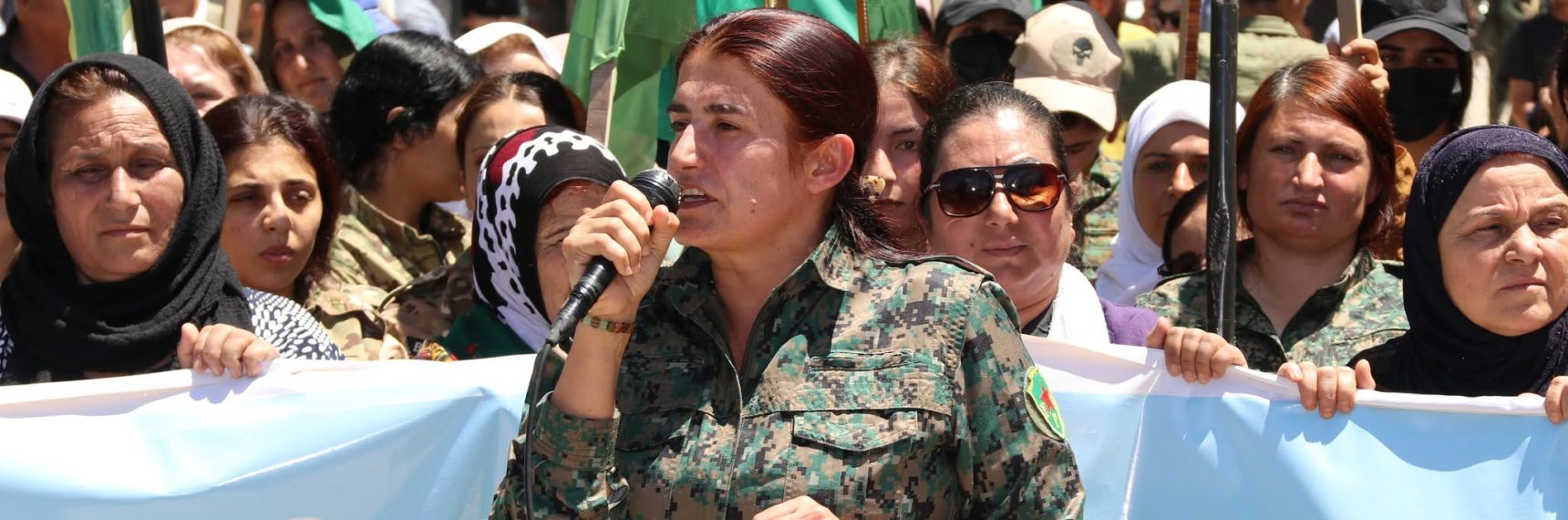
Women’s Defense Units (YPJ) Commander in Chief Rohilat Afrin and Spokeswoman Ruksen Mohamed reaffirmed their commitment to equal rights and equal participation for women as they negotiate the future of their forces in the new Syrian state.
The YPJ was founded in 2013. At the time, conflict and instability in Syria had given rise to new dangers for Kurdish women in the northeast. The YPJ’s founders believed that women must be able to defend themselves and their communities.
The group’s unique all-female command structure and its courage and competence during the war against ISIS won global acclaim. Behind the front lines, its example helped Kurdish women push for greater social and political equality.
When the Syrian Democratic Forces (SDF) began integration talks with the Syrian Transitional Government (STG) after the fall of the Baath regime, YPJ leaders were at the table. Their current demand is for the YPJ’s approximately 2,000 fighters to be allowed to join the four Syrian army brigades created for former SDF personnel under the January 29th, 2026 SDF-STG integration deal. They also want the future Syrian constitution to guarantee women the right to equal participation in all areas of public life, including security and defense.
The State of Integration Talks
Speaking to the Kurdish Peace Institute’s Meghan Bodette on June 16, 2026, Rohilat Afrin warned that women are not being “seen, formally accepted, or included” by Damascus as the integration of the northeast progresses.
The STG, she said, is open to integrating women into internal security roles under the Ministry of Interior (MOI) – but not military roles under the Ministry of Defense (MOD).
“[In northeast Syria] there are many women’s organizations and institutions. In the military realm, we have the YPJ. We also have women in the Asayish, our internal security forces. Now, the government is saying we accept the presence of women in the internal security forces. However, the formalization of this has not yet been determined,” Afrin stated.
“Following our meeting with the Defense Minister of the Transitional Government, as well as other, more general meetings in which we participated, we saw their approach clearly. The foundation of their position is that there is no role for women in the Syrian military,” she continued.
Syria’s international partners have suggested a compromise under which YPJ fighters would be integrated under the MOI.
“In recent weeks, we have engaged and met with U.S. officials, especially Ambassador Tom Barrack’s team. Their approach is that, to protect the existence and experience of the YPJ and respect certain sensitivities in Syria and in the army, the YPJ could be organized as a group within the internal security forces,” Afrin said.
An Army Without Women?
Negotiators may be able to design an internal security role that plays to the strengths and priorities of the YPJ and offers its personnel a future. But this compromise fails to address the serious rights and stability concerns that the total exclusion of women from the Syrian military creates.
“In the 21st century, in any armed force or any institution where women are excluded, you will see violations of women’s rights and of all social values,” said Rohilat Afrin.
She drew attention to atrocities committed in recent years throughout Syria by armed factions that deny women’s rights: the enslavement of Yazidi women by ISIS in 2014 and the violence committed against Druze and Alawite women by armed groups during sectarian clashes in Suwayda and the Syrian coast last year.
Ruksen Mohamed said that women’s participation in the armed forces helps promote equality in civilian life. Exclusion from these institutions, by contrast, could lead to marginalization elsewhere.
“Since the beginning of the Rojava Revolution, we as YPJ were a military force, but we were also a social force. With our will, identity, existence, and ideas, we showed how women could play a leading role in all parts of society. Women saw that they could defend themselves, their identity, language, and society – not just wait for someone else to do it,” she explained.
Key Takeaways
The YPJ will continue to engage in dialogue to ensure a future for its personnel and a guarantee for equal participation in public life for all women in Syria. YPJ leaders see their demands as aligned with international agreements, existing state policy across the Middle East and Europe, and a vision of a new, more equal Syrian state.
“Our presence in the army, our official acceptance, is not a threat to anyone. We believe that this will be accepted across Syria, just as it is across the world and in many Middle Eastern countries,” said Rohilat Afrin.
She noted that United Nations Security Council Resolution 1325 on Women, Peace and Security and the global efforts to implement it could be a precedent and source of knowledge for Syria.
“Our aim is a diverse Syria and a Syria in which women’s existence is protected,” affirmed Ruksen Mohamed.
Afrin and Mohamed laid out three recommendations for governments, international organizations, and civil society groups that wish to support their efforts.
- Observe the process of integration and the creation of new security institutions to monitor the role of women and ensure that women’s participation is not rejected or limited.
- Pressure the Syrian Transitional Government to recognize the right of women to participate in all defense and security institutions, without gender discrimination, and to guarantee the integration of the YPJ into the new system that is being established.
- Support the YPJ, the Syrian Transitional Government, and other relevant actors in integration talks with technical assistance and knowledge sharing on the development of legal and institutional frameworks for the equal participation of women in defense and security institutions.
Topics & Regions
About the Author
Topics & Regions
Explore More
Iran’s Kurdish Alliance Says Their Struggle Will Continue

Related Research
How to Invent a War
The Coalition of Political Forces of Iranian Kurdistan: Risks and Opportunities
YPJ Integration: What are the Obstacles?